Skip to content
No results
  • Frontier Radar
  • Courses
  • Open Source Projects
  • Engineering
  • English
    • 中文
    • 日本語
NoteFlowAI brand logo
Physical AI Lab
  • Frontier Radar
  • Courses
  • Open Source Projects
  • Engineering
  • English
    • 中文
    • 日本語
Sign in
NoteFlowAI brand logo
Physical AI Lab
Sign in
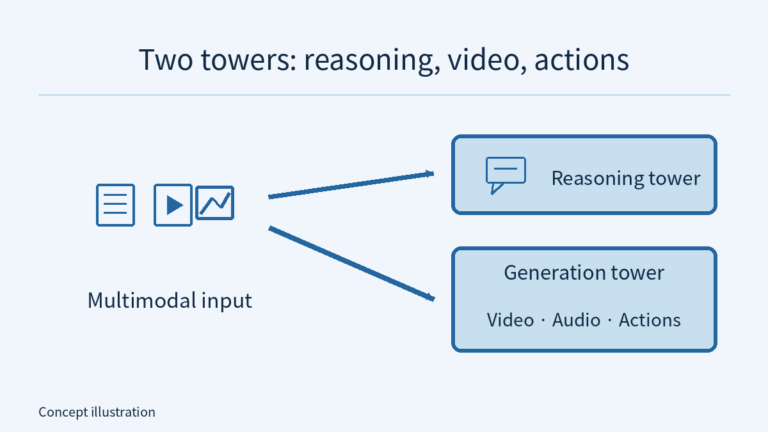
A mixed-modality input glyph branches to the reasoning and generation towers; the generation tower lists video, audio and action outputs. This is a simplified dual-tower schematic, not proof of AWS deployment performance.
  • Frontier Radar

Frontier Radar | NVIDIA Cosmos 3 on AWS: reasoning, video and actions in one forward pass, and the validation conditions attached to instance sizing

AWS on Cosmos 3: full Nano/Super checkpoints tested in BF16; H100 8-GPU SFT tested by NVIDIA. The post provides no benchmark numbers.
  • October 1, 2026
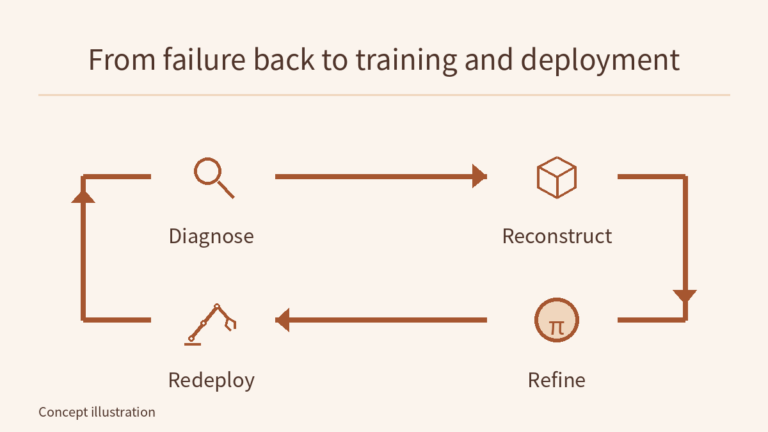
Four-step feedback loop: diagnose a real-robot failure, reconstruct it in simulation, refine the policy, redeploy and return to diagnosis.
  • Frontier Radar

Frontier Radar | F4R: rebuilding real-robot failures as simulation training grounds, in a loop of diagnosis, reconstruction, refinement and redeployment

F4R diagnoses real failures with a VLM agent, rebuilds them in sim and trains around them; authors report 90.0% OOD success, 18.75 pts over Targeted BC.

  • October 1, 2026
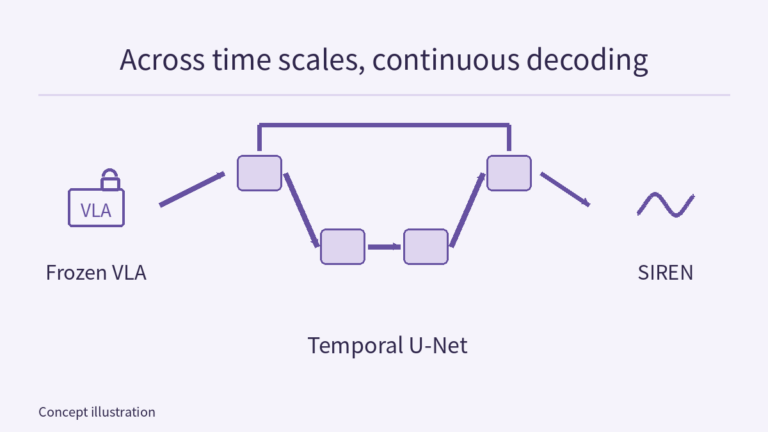
Frozen VLA feeds a simplified temporal U-Net with a skip connection and a SIREN continuous decoder; an axis-free sine glyph represents SIREN activation, not a measured action trajectory, and block counts do not declare the actual model depth.
  • Frontier Radar

Frontier Radar | ActionUNet: a temporal U-Net and a continuous decoder on VLA action features, for multi-scale yet smooth actions

ActionUNet adds a temporal U-Net and SIREN decoder to a frozen VLA; authors report π0.5 gains of 9.8/6.1/11.4 points in robustness tests, 6.46% slower calls.

  • October 1, 2026
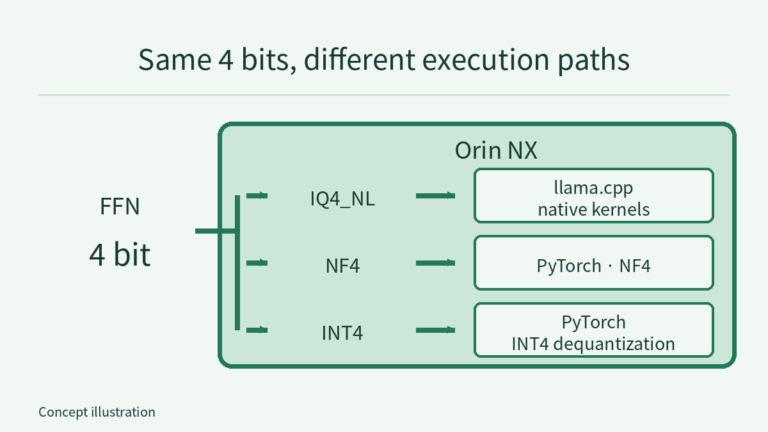
A shared FFN 4-bit setting branches to IQ4_NL, NF4 and INT4 routes on one Orin NX: IQ4_NL uses llama.cpp native kernels, NF4 and INT4 use PyTorch, with INT4 dequantization labelled. Route lengths and box sizes do not encode energy.
  • Frontier Radar

Frontier Radar | EdgeVLN: same 4 bits, 36.8× difference in step energy depending on the execution path

Preprint: 4-bit formats on Orin NX differ 36.8× in step energy; IQ4_NL has the lowest energy and resident memory, while NF4 and INT4 also run on-board.

  • October 1, 2026
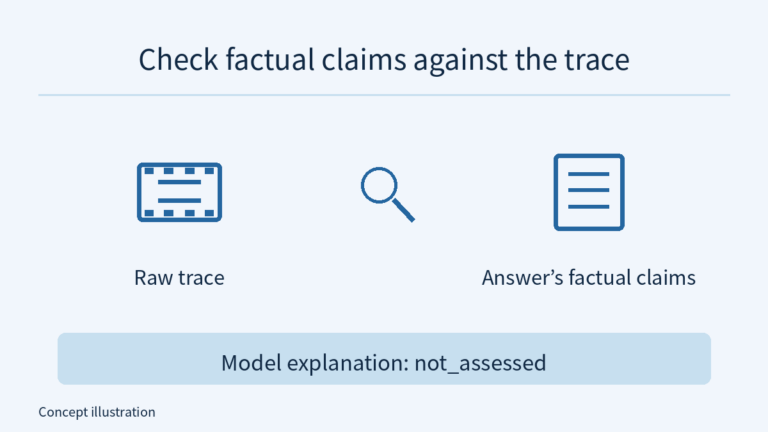
The raw trace on the left and the answer’s factual claims on the right flank a neutral inspection lens; a separate lower panel labels the model explanation not_assessed, outside automatic factual checking.
  • Engineering

Checking a model’s explanation against the original robot recording: what Robot Reel’s review-claims can establish

Match a raw answer to a SmolVLA trace. Explanation: not_assessed; unassessed facts give exit 1. Keep format failures unchanged.

  • October 1, 2026
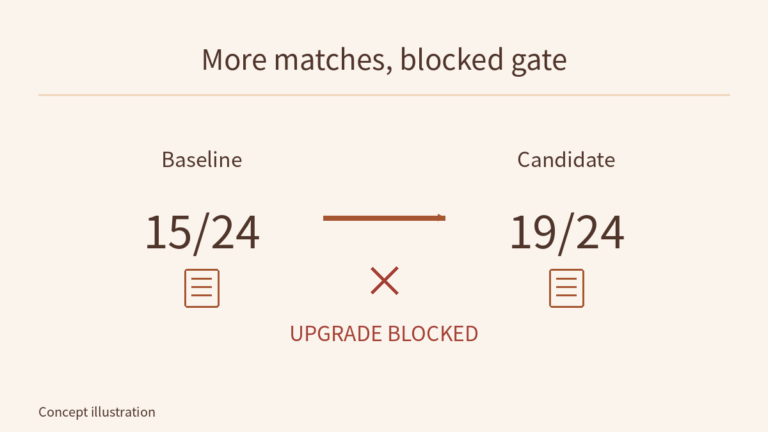
Baseline complete-plan matches are 15/24 and the candidate has 19/24; a blocked gate indicates that case-level checks still reject the upgrade.
  • Engineering

Reviewing a model upgrade: complete-plan matches rose from 15/24 to 19/24, so why does the EvalArc gate still reject it?

Recompute a model-upgrade verdict from pinned, verified records: the total rose, yet 10 blocking checks trace to format or schema failures in two cases.

  • October 1, 2026
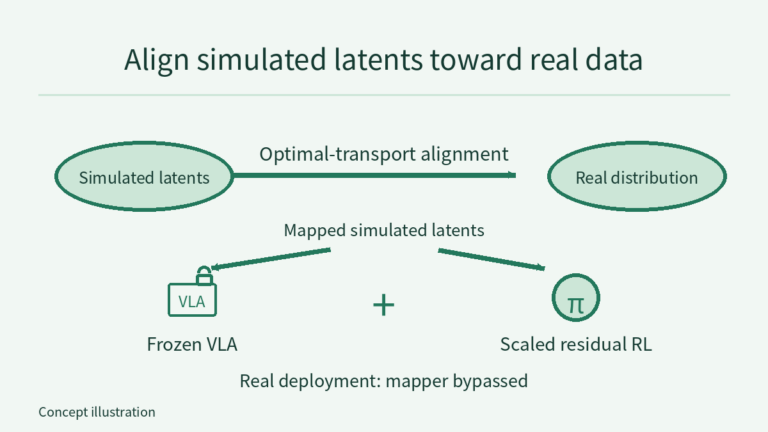
Schematic ellipses show simulated latents aligned toward the real distribution with optimal transport; mapped simulated latents feed the frozen VLA and simulation-trained scaled residual RL, whose actions are added. A separate note states that real deployment bypasses the mapper; the ellipses are not measured distributions.
  • Frontier Radar

Frontier Radar | VLaRL: a frozen VLA, residual RL trained only in simulation, and VLM latents to bridge the visual sim-to-real gap

Frozen VLA plus a sim-only residual on VLM latents aligned by an optimal-transport mapper; authors report real-robot gains in all 8 task–backbone pairs.

  • September 29, 2026
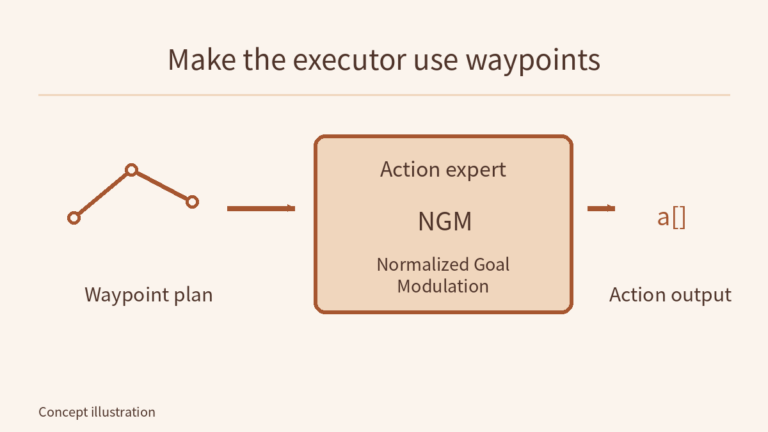
An illustrative waypoint path enters the action expert, with Normalized Goal Modulation (NGM) inside the expert and action output on the right; NGM is not a separate model layer, and no new latency measurement is shown.
  • Frontier Radar

Frontier Radar | Fast Plans, Faithful Actions: when a hierarchical VLA plans too slowly and its executor ignores the plan

π0.5-derived waypoint VLA: plans took 57 serial passes, endpoint erasure didn't hurt success. Authors cut robot planning 1094→125 ms; NGM makes plans count.

  • September 29, 2026
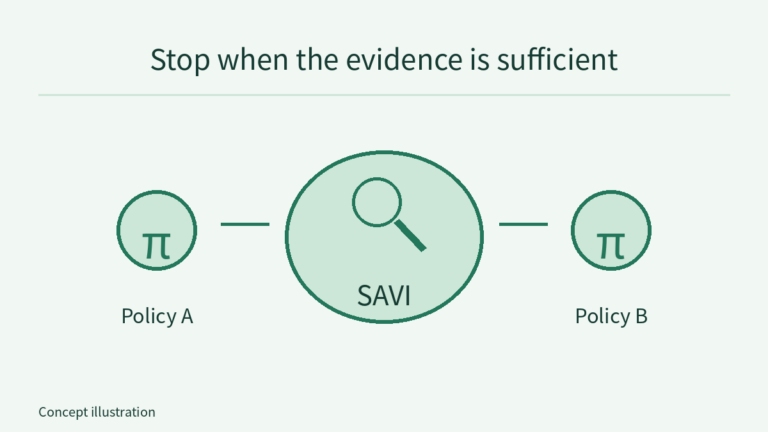
Two policies flank SAVI inspection, illustrating policy comparison through SAVI without trial counts, a depicted stopping time or a reward curve.
  • Frontier Radar

Frontier Radar | Beyond Binary Success: sequential tests that separate robot policies with fewer real-world rollouts

Sequential robot policy comparison via safe anytime-valid inference, for non-binary metrics too; authors report up to 70% less evaluation vs batch tests.

  • September 28, 2026
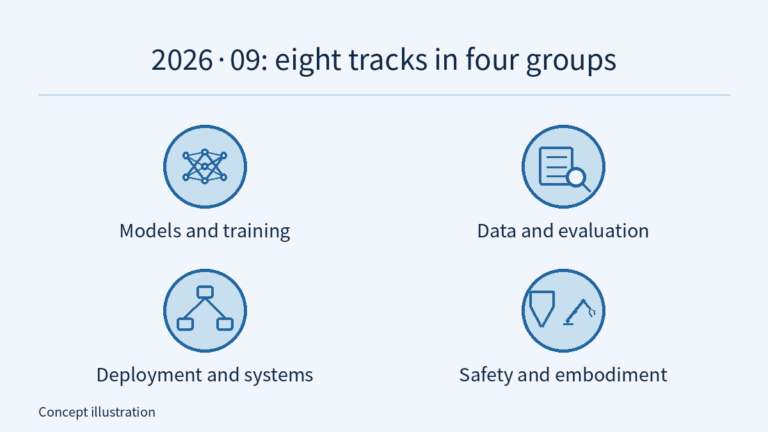
The article’s eight tracks form four groups: models/training, data/evaluation, deployment/systems and safety/embodiment. Learning-network, data-table review, service-orchestration and neutral shield/robot glyphs name the themes; circles are not statistical counts or certifications.
  • Frontier Radar

Embodied AI frontier highlights, September 2026: 14 key items across eight tracks

14 items from the Physical AI Radar's September archive, numbers checked: VLA evaluation starts testing recovery; latency becomes a formally reported metric.

  • September 28, 2026
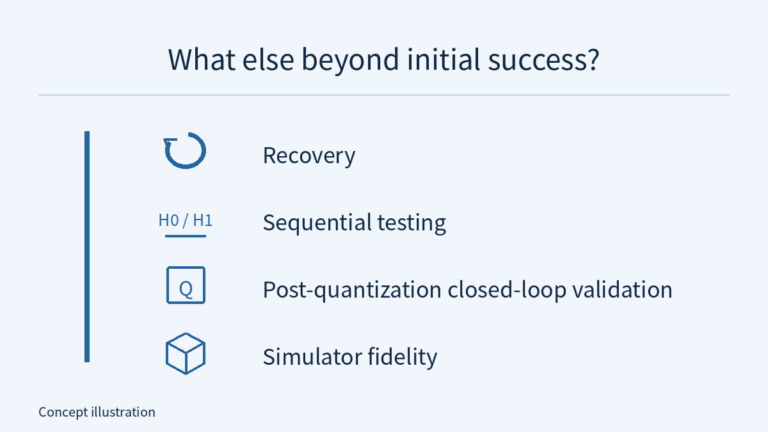
Recovery, sequential testing, post-quantization closed-loop validation and simulator fidelity are four vertically listed perspectives. Return, H0/H1 testing, quantization and scene glyphs name the topics, without gauges, measured scores or a required order.
  • Frontier Radar

Frontier Radar deep dive | Simulation and evaluation: what VLA evaluation is missing beyond initial-state success rate

7 primary sources: recovery benchmarks, sequential testing, post-quantization closed-loop checks, sim fidelity. 98.83% initial success, only 48% recovery.

  • September 28, 2026
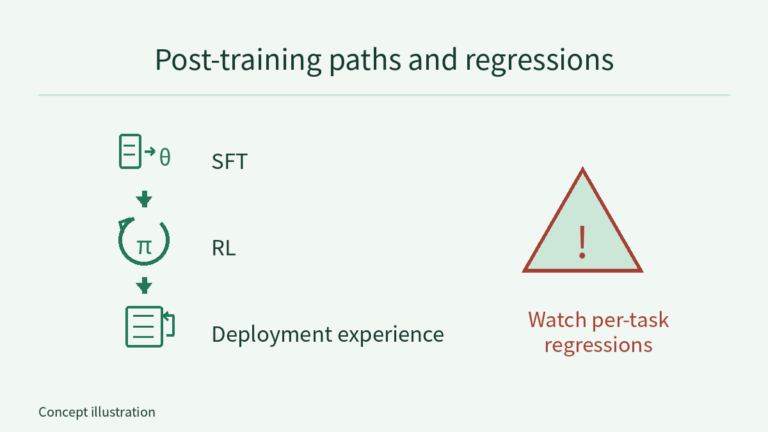
SFT, RL and deployment experience are connected vertically with demonstration-training, reward-feedback and deployment-record glyphs; a side warning names per-task regressions without promising continuous gains.
  • Frontier Radar

Frontier Radar deep dive | Training and self-improvement: three stages of VLA post-training and task collapse in online RL

Half-day SFT, RL post-training, learning from deployment: 7 radar sources outline VLA post-training, and the risk that online RL silently breaks single tasks.

  • September 28, 2026
Prev
1 2 3 4 5 6
Next
© 2026 Physical AI Lab
  • Privacy Policy

Physical AI Lab · AI Assistant

AI
Hi! I'm the Physical AI Lab's AI assistant. Ask me anything about robotics, embodied AI or the course.

Sign in to chat with the assistant.

Sign in
Powered by Amazon Bedrock