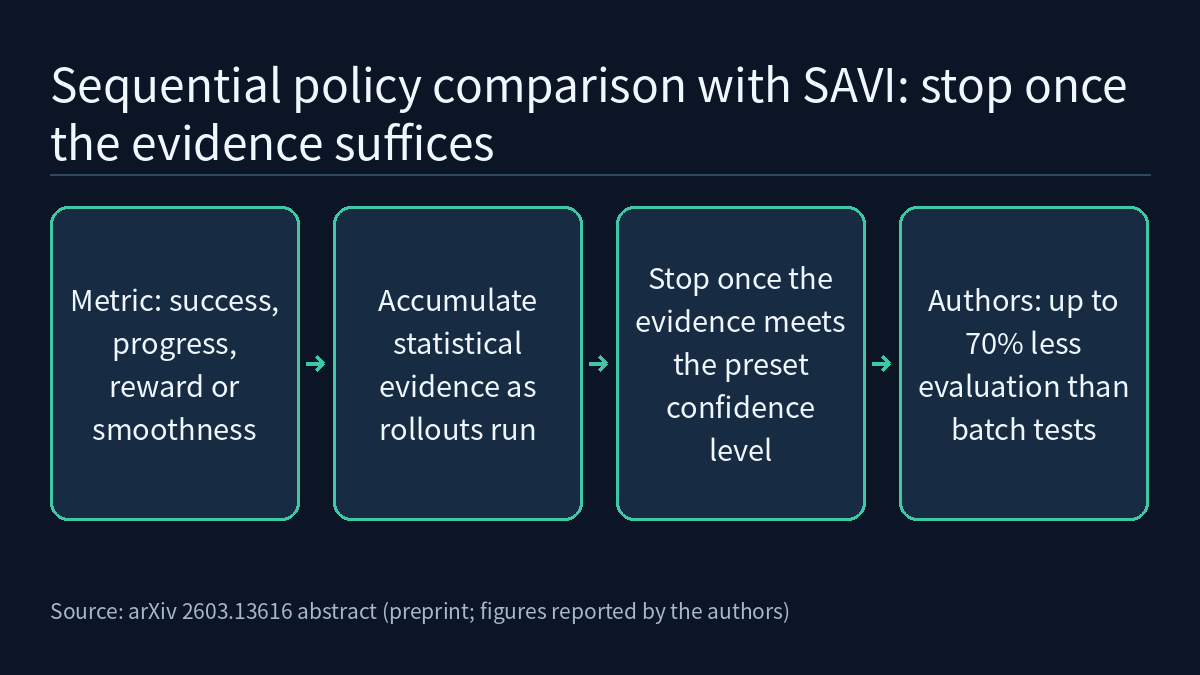
When you compare two robot manipulation policies on real hardware, the rollouts themselves are the expensive part: you can afford only a few, yet the result is used to decide whether a model has improved. Beyond Binary Success, a paper listed on a Toyota Research Institute (TRI) research page (arXiv 2603.13616, v1 submitted 2026-03-13, evidence level [R]), proposes a sequential comparison method based on safe, anytime-valid inference (SAVI). Evaluation proceeds trial by trial and can stop early once there is enough statistical evidence, while keeping a pre-specified confidence level. It is not limited to binary success rate; it also covers metrics such as task progress, episodic reward and trajectory smoothness.
The problem: too few real-robot rollouts
The abstract starts from this observation: generalist robot manipulation policies are becoming increasingly capable, but their evaluation is still limited to a small number of hardware rollouts. The authors argue that this resource constraint calls for two things at once: more informative performance measures, and reliable, efficient evaluation procedures. Both are needed to assess model capabilities properly and to benchmark progress in the field.
The paper handles both requirements in one framework: a single test procedure that saves trials and also works with metrics finer than success/failure. The abstract describes the framework as sample-efficient, statistically rigorous, and applicable to a broad set of evaluation metrics used in practice.
The method: sequential testing that stops when the evidence suffices
The abstract compares the new method with two kinds of existing approach. One is “standard batch methods”: in contrast to sequential methods, you fix the number of evaluations in advance, run them all, and then test. The other is earlier sequential procedures designed for binary success. The SAVI procedure is itself sequential: the evaluator does not have to run a fixed number of trials, and can stop once the accumulated statistical evidence is enough to reach a decision at the pre-specified confidence level.
The abstract does not give the specific test statistic, the stopping rule, or the confidence levels used. To apply the method in your own evaluation pipeline you need the full paper (the arXiv page lists 12 + 9 pages and 2 + 5 figures).
Beyond success/failure: which metrics it covers
The authors stress that previous work was developed for binary success, whereas their unified approach covers a much wider range of metrics and spans both parametric and nonparametric comparison problems. The examples named in the abstract:
| Value type | Examples in the abstract |
|---|---|
| Binary | Success / failure (the scope of earlier sequential methods) |
| Discrete | Partial-credit task progress |
| Continuous | Episodic reward, trajectory smoothness |
For teams that already record task stages or rewards, this means those records do not have to be collapsed into a single success rate before the comparison is tested.
Results reported by the authors
The authors validated the method on simulated and real-world evaluation data and report the following, all taken from the paper’s abstract:
- Up to 70% reduction in evaluation burden compared with standard batch methods.
- Up to 50% reduction compared with state-of-the-art sequential procedures designed for binary outcomes.
- These savings come “with no loss of statistical rigor”.
- Competing policies can be separated more quickly with fine-grained task progress than with binary success metrics.
The last point matters most for evaluation design: binary success throws away the information about how far the policy got, and the authors’ results show that, when samples are scarce, keeping that information lets a comparison reach a conclusion sooner. This site’s earlier article “Frontier Radar deep dive | Simulation and evaluation: what VLA evaluation is missing beyond initial-state success rate” also covered this paper; this article looks at it on its own.
Limitations
- This is an arXiv preprint (category cs.RO, cross-listed in stat.AP); the arXiv page does not name a conference or journal. All figures above are reported by the authors, and the material this article is based on contains no independent reproduction.
- Both 70% and 50% are “up to” figures, i.e. best-case savings. The abstract gives no average saving and does not say under which tasks, policies or rollout counts they were achieved.
- “Statistically rigorous” holds under the paper’s own assumptions, which the abstract does not list. Check that your data meet them before relying on the method.
- Task-progress levels have to be defined by people, and the abstract does not discuss whether conclusions under different definitions are comparable.
- The material this article is based on contains no link to a code repository, so it is not yet clear whether an implementation can be reused directly.
Links
- TRI research page: Beyond Binary Success
- arXiv 2603.13616: Beyond Binary Success: Sample-Efficient and Statistically Rigorous Robot Policy Comparison (authors: David Snyder, Apurva Badithela, Nikolai Matni, George Pappas, Anirudha Majumdar, Masha Itkina, Haruki Nishimura)
- DOI 10.48550/arXiv.2603.13616