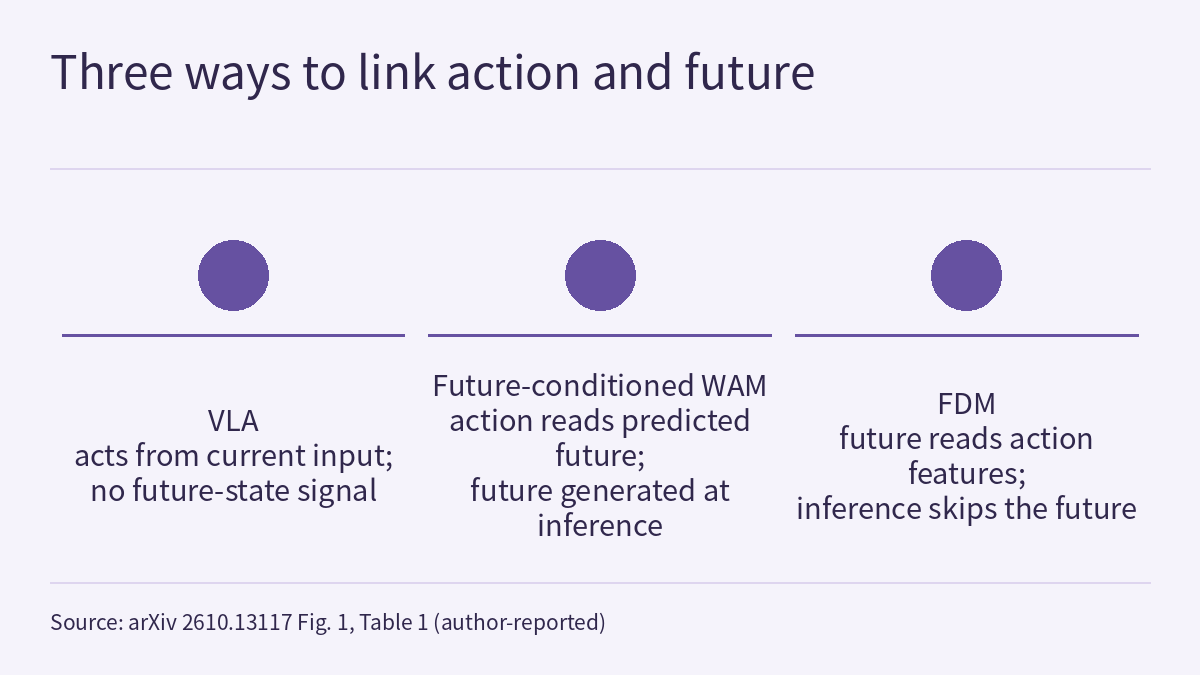
Forward Dynamics Models (FDM, arXiv 2610.13117, 2026-10-09), a preprint by authors from the School of Data Science at Fudan University and other institutions, is about one design choice in robot action models: between action prediction and future-state prediction, which one reads the other. A VLA maps the current observation and instruction straight to actions and gets no supervision about what happens next during training. A common future-conditioned world action model (WAM) predicts the future first and infers actions from it, so it must generate the future at inference, and errors in that prediction flow into the actions. FDM reverses the direction: during training, the future-prediction branch reads action features and the future loss backpropagates through them into the policy; the action path never sees future information, so inference can skip future generation entirely. The authors report a 99.4% average success rate on LIBERO and 96% on five real-robot tasks with a dual-arm ARX-X5 (π0.5: 83%). All numbers below are author-reported [R]; this site has not reproduced them.
Three directions of dependency
Table 1 of the paper compares three model families in one notation: C = (O_t, L) is the current observation and task instruction, A the action chunk, and V the future world-state target.
| Model family | Training | Inference |
|---|---|---|
| VLA | p(A | C) | p(A | C) |
| Future-conditioned WAM | p(V | C) · p(A | C, V) | p(V | C) · p(A | C, V) |
| FDM | p(A | C) · p(V | C, A) | p(A | C) |
The authors stress that this factorization is only a conceptual statement of the dependencies; what does the work is a representation-level connection. The future-prediction branch reads the action expert’s hidden states H_a, not the final numerical action. The gradient of the future loss with respect to H_a flows back into the action-expert parameters that produce H_a, so ground-truth future states supervise the internal features used to generate actions.
Both instantiations connect several experts layer by layer through attention in a mixture-of-transformers (MoT) architecture, and an asymmetric attention mask sets who may read whom: context reads only context; action reads context and action; future generation may read all three groups. The paper notes that the restriction also covers indirect paths: the context features available to the action expert must themselves be independent of generation-branch tokens.
Two instantiations: one on a VLM, one on a video generative model
FDM w/ VLM. A randomly initialized generation expert with the same architecture as the action expert is added to π0.5. It reads Wan VAE latents of the frame 15 recorded frames earlier and of the current frame, plus context and action features, and directly regresses the latent of the frame 15 frames ahead for each camera view, with an MSE loss in a single forward pass and no visual denoising loop. The context expert processes only the current images and instruction, so the historical frame serves only training-time future prediction and is not needed at deployment. At deployment the generation expert and its VAE processing can be dropped.
FDM w/ VGM. A randomly initialized action expert is added to the video generative model Wan2.2-5B. The video backbone handles both context processing and future generation: the current-frame latent stays clean, the future video latents are noised and trained with flow matching, and the loss is computed only on future latents. Within the same generation expert, current-observation tokens and future-video tokens have different attention permissions, and the action expert can read only the former. At deployment the current-observation processing is kept and its keys and values are cached at each layer; each action-denoising step updates only the action stream and allocates no future-video tokens.
In both, the total loss is the action flow-matching loss plus the future loss, with weights λ_a = λ_v = 1. Training uses 8 NVIDIA H100 GPUs and inference runs on one H100. Neither FDM model uses robot policy pretraining, while the compared π0, π0.5, Motus and LingBot-VA all do.
Results: two simulation benchmarks and five real-robot tasks
| Benchmark | Method | Average success (%) | Comparisons in the same group |
|---|---|---|---|
| LIBERO (4 suites) | FDM w/ VLM | 99.4 | π0 94.1, π0.5 96.9 |
| LIBERO (4 suites) | FDM w/ VGM | 98.1 | Motus 97.7, LingBot-VA 98.5 |
| RoboTwin 2.0 (50 tasks) | FDM w/ VLM | 81.20 | π0 62.16, π0.5 79.75 |
| RoboTwin 2.0 (50 tasks) | FDM w/ VGM | 89.23 | Motus 87.8, LingBot-VA 92.20 |
The abstract’s “state-of-the-art 99.4%” comes from the VLM group. Looked at separately, FDM is not best in several places: in the VGM group it is below LingBot-VA on both the LIBERO and RoboTwin averages, and on LIBERO-Long FDM w/ VGM reaches 94.2%, below Motus’s 97.6% and LingBot-VA’s 98.5%. Under RoboTwin’s Clean condition FDM w/ VLM scores 81.54%, below π0.5’s 82.74%; its advantage comes from the randomized condition (80.86% vs 76.76%).
The real-robot experiments use a dual-arm ARX-X5 on five tasks: drawer packing, box packing and closing, inserting two shuttlecocks, cup stacking and block stacking, with 20 trials per method per task. FDM w/ VLM averages 96% against π0.5’s 83%; FDM w/ VGM averages 83% against 78% for FastWAM-Joint and 71% for DreamZero. In this site’s reading, the abstract’s “absolute gains of up to 13%” on real robots is consistent with the 13-percentage-point gap in the 96% vs 83% pair; the paper does not state this mapping. FastWAM-Joint here is the authors’ own future-conditioned WAM, with the same architecture as FDM w/ VGM and only the direction of cross-expert attention reversed; it is a clean control, but not a model released by another paper.
Ablation: what is the backward path worth?
The authors compare four variants on the five real-robot tasks, with the same training seeds and action-only inference:
| Variant | Future supervision | Future branch reads H_a | Future loss backpropagates through H_a | VLM average (%) | VGM average (%) |
|---|---|---|---|---|---|
| A. Action-only | No | No | No | 83 | 66 |
| B. Context-only future | Yes | No | No | 87 | 72 |
| C. Stop-gradient | Yes | Yes | No | 89 | 78 |
| D. Full FDM | Yes | Yes | Yes | 96 | 83 |
C and D have identical forward computation; they differ only in whether gradients pass through the action-feature interface during training. The 7- and 5-point gains of D over C are therefore the authors’ evidence for the value of backward supervision itself. B beats A by 4 and 6 points, showing that plain visual co-training with a future objective already helps; D adds another 9 and 11 points over B, which mixes the effects of forward reading and backward supervision. The authors also report that the future gradients passed back through the action interface have mostly positive cosine similarity with the action-imitation gradients.
Error propagation and compute cost
The authors inject Gaussian noise once into FastWAM-Joint’s future-video latent midway through joint denoising, leaving the observation and noised action chunk unchanged. At perturbation strength α = 1.0, action error rises by 4.44% on LIBERO, 5.52% on RoboTwin and 0.22% (Box) to 1.17% (Cup) on the five real-robot tasks; small perturbations slightly lower the error on LIBERO and Box. The authors report no such measurement for FDM: the action path never reads generated futures, so with parameters, inputs and sampling randomness fixed, perturbing the future cannot change the action. FDM’s zero line in the figure is a structural invariance, not a measurement.
| Method | Training step time (s) | Peak memory (GiB/GPU) | Inference latency (ms/chunk) |
|---|---|---|---|
| π0.5 | 0.4436 | 67.08 | 203.77 |
| FDM w/ VLM | 0.6305 (+42.14%) | 72.04 | 202.98 |
| FastWAM-Joint | 0.9754 | 66.80 | 446.55 |
| FDM w/ VGM | 0.9729 (−0.26%) | 66.80 | 253.45 (1.76× speedup) |
The two routes pay in different places: the VLM version matches π0.5’s inference latency but is 42.1% slower per training step; the VGM version keeps training cost essentially unchanged and, by dropping future-video generation, infers 1.76× faster than FastWAM-Joint (rounded to 1.8× in the text).
How this relates to existing pages on this site
Physical AI Lab 1.6: Imitation Learning covers behavior cloning and action chunking: a policy learns “what to do given what it sees” from demonstrations. FDM points at exactly the signal that training lacks, “what happens after I act”, and adds it without changing deployment-time action inference, which still denoises an action chunk from the current observation and instruction alone.
HWAM, covered earlier in Frontier Radar, takes another route: it concatenates the post-execution proprioceptive state with the action and denoises them together, so the action channel can see the partially denoised state channel. FDM explicitly forbids the action from reading any future information. The two papers differ in prediction target (proprioceptive state vs future image or video latents), platform and tasks, so their numbers cannot be compared; what can be set side by side is the direction of dependency as a design axis.
When reading the real-robot numbers, the questions from Physical AI Lab 1.8: Evaluation apply: 20 trials per method per task, 100 across the five tasks; the text read gives no confidence intervals or variation across training seeds, and the paper does not say how much of the few-point gaps between ablation variants lies within sampling error.
Limitations
- This is an arXiv preprint; all numbers are author-reported [R] and this site has not reproduced them. The paper lists a project page, which this site has not checked.
- FastWAM-Joint is the authors’ own implementation; the perturbation analysis and efficiency comparison are based on it and do not represent other released WAMs.
- FDM’s insensitivity to future perturbations holds by construction, not by experiment. FastWAM-Joint’s action-error increase at α = 1.0 ranges from 0.22% to 5.52%; the paper does not separately measure how much an increase of this size affects closed-loop success.
- FDM uses no robot policy pretraining while the baselines do; the training set-ups differ, so the gaps in the tables cannot be attributed entirely to the direction of dependency.
- The real-robot part covers one dual-arm ARX-X5 and five tasks with no confidence intervals; the ablation compares average success rates only.
- The text read by this site is truncated at Appendix A.5 and does not include Appendix C (training hyperparameters), Appendix D (hardware and task details) or Appendix E (per-task RoboTwin results).
- The paper’s AI use statement says generative AI was used only to assist with writing, LaTeX formatting and information retrieval, not for the method, experiments, code, data processing or interpretation of results.
Links
- Forward Dynamics Models (arXiv 2610.13117)
- Full paper in HTML
- Frontier Radar | HWAM: a humanoid’s reference action is not the motion it performs, so generate the post-execution body state alongside it
- Physical AI Lab 1.6: Imitation Learning — Working Out How an Error Rolls Out of the Demonstrations’ Coverage, Then Putting the ACT, Diffusion Policy and Data Scaling Numbers Back in Their Own Conditions
- Physical AI Lab 1.8: Evaluation — Splitting a “Net Gain of 2” into a Paired Table, Then Checking the Failure Labels and Random Seeds
- Physical AI Lab: a physical AI course where every number can be checked (course outline)