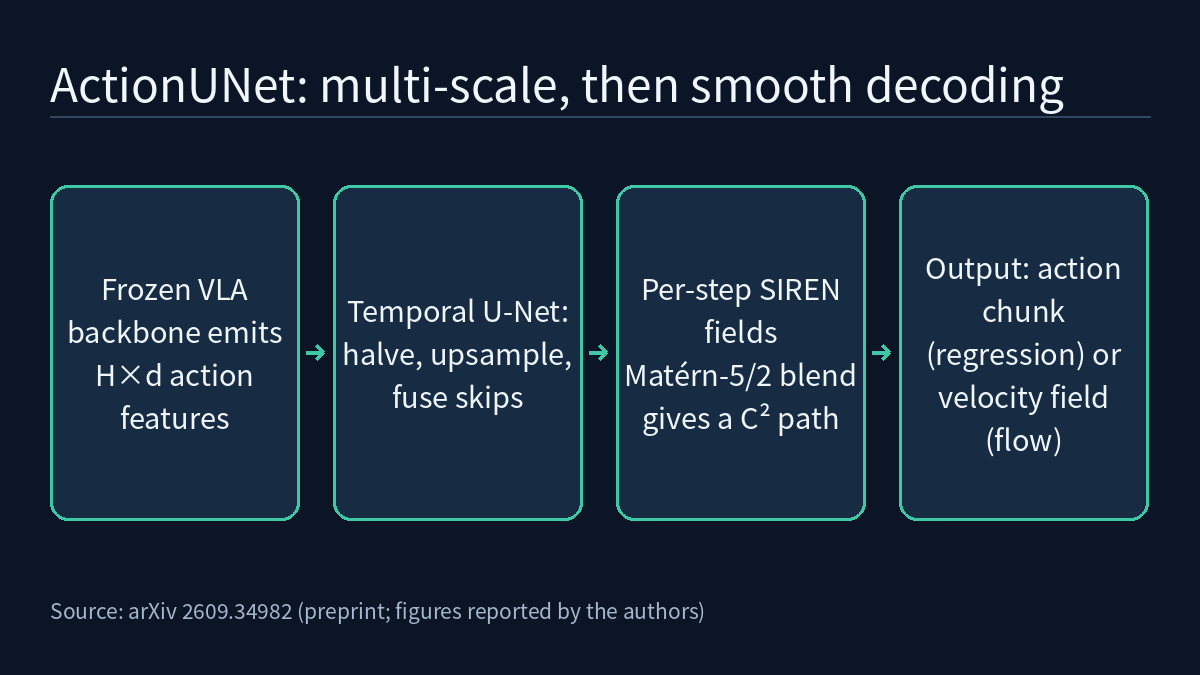
A VLA’s action expert usually maps the high-level semantics from its vision-language model onto actions step by step, yet within a single task some phases involve large arm movements and others involve only small, fine-scale per-step motions. ActionUNet, a preprint from a University of Chinese Academy of Sciences team (arXiv 2609.34982, 2026-09-28, evidence level [R]), calls this difference a “temporal scale mismatch” and adds two lightweight modules behind a frozen VLA backbone: a temporal U-Net that encodes the action features at multiple scales, and a conditional SIREN decoder that keeps each action chunk twice continuously differentiable. The authors report that π0.5’s success rate rises by 9.8, 6.1 and 11.4 percentage points on the RoboTwin 2.0 hard setting, LIBERO-Plus and the real-robot hard setting respectively, while a single policy call becomes about 6.5% slower. The ablation is the part worth reading: used alone, each module improves one setting and hurts the other.
The problem: one action chunk mixes motions at different scales
The authors characterise “action scale” as the sum of the left and right end-effector displacements between two consecutive recorded steps: large displacements are coarse-scale motions, small ones fine-scale motions. Figure 1 of the paper shows that this quantity varies widely not only between tasks but also between stages of the same task (for example Stack Blocks Two). The unit is m/step, and the authors state explicitly that it is a dataset-level proxy for scale, not a physical execution velocity.
Their argument is that in standard fine-tuning the action head decodes each timestep independently from high-level multimodal features, which is a single-scale mapping; the model therefore over-relies on abstract semantics and misses the fine-grained temporal cues needed to resist local perturbations. Introducing multi-scale representations directly has its own cost, though: when features of different granularity are combined, interpolation errors appear at the scale boundaries, trajectories stop being smooth, and mechanical oscillation follows. The two modules address these two problems in turn.
Method: a temporal U-Net plus a conditional SIREN decoder
- Temporal U-Net: the VLA produces features aligned with the action timesteps, of shape H×d (H is the action chunk length). Each encoder stage halves the temporal resolution with a 1D convolution (downsampling rate r = 2), followed by GeLU and LayerNorm; the bottleneck passes through one fully connected layer; each decoder stage upsamples by 2 with nearest-neighbour interpolation, concatenates the matching encoder feature and fuses them with a single linear layer, until the shape is back to H×d.
- Local SIREN fields: the action chunk is treated as samples of a continuous trajectory over normalised time τ ∈ [−1, 1]. The feature of each timestep is the conditioning input of one local SIREN field (a SIREN is a small network with sine activations), and the usual fixed biases are replaced with affine functions of τ so that every layer is explicitly aware of time.
- Matérn-5/2 weighted fusion: a normalised Matérn-5/2 kernel with length-scale ρ = 0.2 weights these local fields by their distance from the query time and sums them. The appendix derives that the fused function is twice continuously differentiable (C²) on [−1, 1].
- Output: for a regression policy (OpenVLA-OFT) the output is the action chunk itself, trained with an ℓ1 loss; for a flow-matching policy (π0.5) it is the velocity field, trained with the base policy’s loss, but the white noise is replaced with temporally correlated noise sampled from a Matérn-5/2 covariance so that the denoising target is smoother too.
During training the pre-trained backbone stays frozen; only the action expert and the new modules are fine-tuned, under the base policy’s original objective. Fine-tuning π0.5 on RoboTwin 2.0 used 2 RTX 4090 GPUs for 8K steps; on LIBERO it used 8 A800 GPUs for 40K steps. The paper says code and implementation details are available in the authors’ GitHub repository; this article did not check the repository’s contents.
Results reported by the authors
From the 50 bimanual tasks in RoboTwin 2.0, 12 were selected; each is trained on 50 clean demonstrations and evaluated over 100 rollouts in both the easy and the hard setting (distractors, backgrounds, lighting, table heights and language vary). For LIBERO-Plus, models are trained on LIBERO and evaluated directly under 7 perturbation types. The real robot is a Realman Gen72 dual-arm platform with 3 tasks and 50 rollouts per task and setting; the hard setting adds random distractor objects.
| Evaluation (average success rate) | Baseline | +ActionUNet | Change (points) |
|---|---|---|---|
| π0.5, RoboTwin 2.0 easy (12 tasks) | 59.6% | 68.4% | +8.8 |
| π0.5, RoboTwin 2.0 hard (12 tasks) | 29.8% | 39.6% | +9.8 |
| π0.5, LIBERO (4 suites) | 95.6% | 97.7% | +2.1 |
| π0.5, LIBERO-Plus (7 perturbation types) | 65.8% | 71.9% | +6.1 |
| π0.5, real robot easy (3 tasks) | 76.0% | 88.7% | +12.7 |
| π0.5, real robot hard (3 tasks) | 57.3% | 68.7% | +11.4 |
| OpenVLA-OFT, LIBERO | 97.9% | 98.6% | +0.7 |
| OpenVLA-OFT, LIBERO-Plus | 60.9% | 64.6% | +3.7 |
On LIBERO-Plus, π0.5 improves under all 7 perturbation types. The largest gains are for camera (48.2% → 56.9%), robot state (45.9% → 54.4%) and sensor noise (52.0% → 61.1%); lighting (93.0% → 94.6%) and background (87.4% → 89.8%) gain less. Not every one of the 12 RoboTwin 2.0 tasks improves: Press Stapler in the easy setting goes from 74% to 73%, and Handover Mic in the easy setting is 100% for both. The numbers for other methods in the tables, such as RDT, π0 and ACT, are cited from earlier papers; the authors reproduced only π0.5 and OpenVLA-OFT themselves.
Ablation: each module alone leans one way
The ablation uses 4 RoboTwin 2.0 tasks on top of π0.5 (so the full method’s numbers differ from the 12-task average):
| Variant | Easy | Hard |
|---|---|---|
| π0.5 | 69.0% | 34.5% |
| + temporal U-Net only | 67.5% | 37.3% |
| + SIREN decoder only | 75.5% | 33.3% |
| ActionUNet without the Matérn kernel | 75.0% | 45.3% |
| Full ActionUNet | 77.8% | 46.5% |
With the U-Net alone the hard setting improves and the easy setting gets worse; with SIREN alone it is the other way round. The authors’ reading is that the multi-scale structure brings robustness to distractors but breaks the continuity of actions, while the continuous decoder suppresses jitter but cannot supply a multi-scale representation. Combined, even before the Matérn kernel is added, they raise the hard setting by 10.8 points, and the Matérn kernel adds another 1.2 points. The authors also use Grad-CAM to show that the fine, middle and coarse layers of the U-Net respond most strongly to ground-truth actions of the corresponding scale; this indicates that the representation is scale-related, but it is not causal evidence in itself.
Overhead
On a single RTX 4090, with an action chunk length of 50, 10 flow-matching steps and torch.compile enabled, one policy call goes from 60.947 ± 0.251 ms to 64.886 ± 0.376 ms, 3.939 ms more (+6.46%). Scaled by the average number of steps in successful rollouts, the cumulative policy computation per RoboTwin 2.0 rollout grows by 0.934 s in the easy setting; in the hard setting the average step count falls from 276.43 to 264.29, which offsets part of it, for an increase of only 0.301 s. The authors note that these figures cover policy computation only, not end-to-end robot execution latency.
How this relates to earlier articles on this site
The VLA concept is introduced in “Physical AI Lab 0.2: Why Now? The Three Curves of Data, Models, and Compute”. “Fast Plans, Faithful Actions” also builds on π0.5 and deals with two problems in a hierarchical VLA: plan generation that is too slow, and an executor that does not follow the plan. ActionUNet does not touch planning; it changes how action features are decoded into an action chunk.
“Frontier Radar deep dive | Simulation and evaluation” discussed what success rates from standard starting states leave out. ActionUNet’s numbers also show why standard and perturbed conditions should be read separately, but they do not reduce to “the gain is larger under perturbation”: the LIBERO baseline is already 95.6%, leaving at most 4.4 points of headroom, so the +6.1 on LIBERO-Plus is the more informative figure; on RoboTwin 2.0 the hard-setting gain (+9.8) is slightly larger than the easy-setting gain (+8.8), whereas on the real robot the easy-setting gain (+12.7) is larger than the hard-setting gain (+11.4). On latency, the 6.46% per-call increase can be read within the latency-budget framing of “Frontier Radar deep dive | Edge and real-time”; note, however, that that article focuses on edge devices, whereas the numbers here were measured on an RTX 4090.
Limitations
- This is an arXiv preprint; all numbers are reported by the authors, and the material this article relies on contains no independent reproduction.
- The real robot uses 50 rollouts per condition and RoboTwin 2.0 uses 100; the main text and Appendices A–C read for this article give no confidence intervals or significance tests for success rates. The later appendices were not reviewed and may contain a statistical comparison (for example, §I.2 cites a sequential policy-comparison method). Whether or not they do, at these sample sizes small per-task differences (such as 74% versus 73%) should not be interpreted on their own; “Beyond Binary Success” described statistical methods for comparing two policies when trials are limited, which may serve as a reference.
- The C² continuity proof applies within a single action chunk. The limitations the authors list include modelling action chunks independently, using fixed temporal scales, and introducing scale-aware modelling only at the downstream action stage; the transition from one chunk to the next is outside the guarantee.
- RoboTwin 2.0 uses only 12 of its 50 tasks, chosen by the authors according to temporal scale composition; the real-robot evaluation covers one platform and 3 tasks.
- RoboTwin 2.0 and LIBERO used different GPUs and step counts, and OpenVLA-OFT+ActionUNet on LIBERO used a lowered learning rate; keep these differences in mind when comparing gains across benchmarks.
Links
- arXiv 2609.34982: ActionUNet: Improving Robustness of VLA Models with Efficient Multi-scale Fine-tuning (authors: Di Zhu, Ziheng Yan, Fang Wan)
- Full paper in HTML