
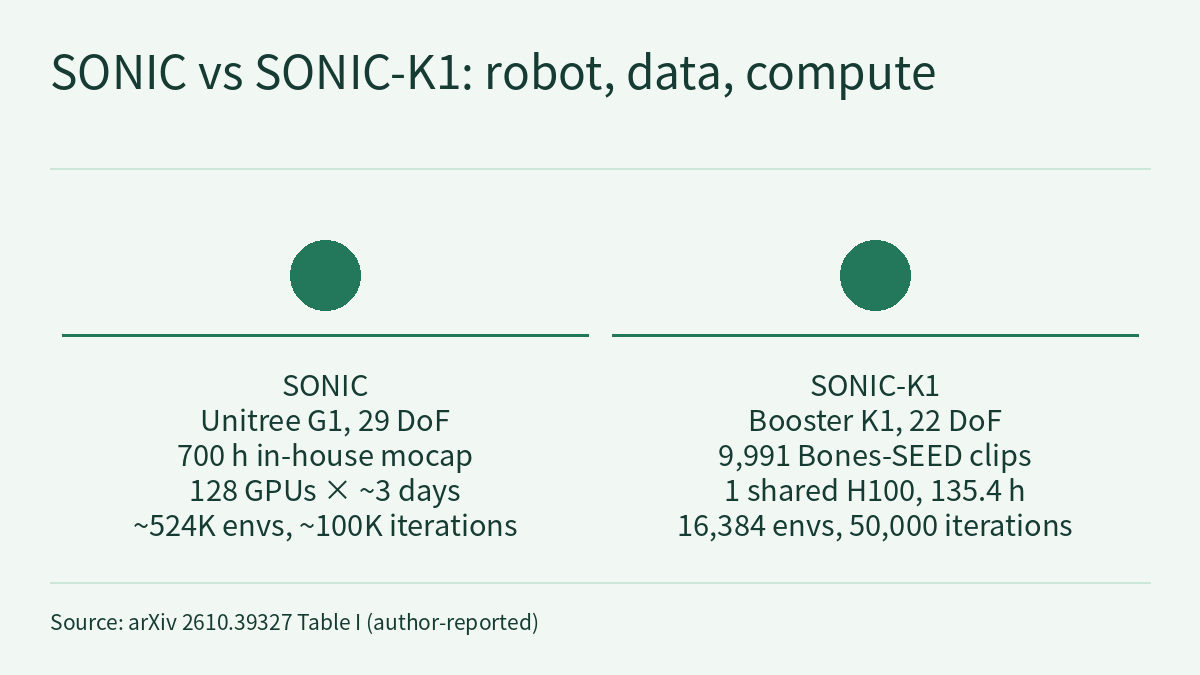
A general motion tracker is a single policy that takes a reference trajectory and outputs joint commands. Once a robot has one, motion capture, pose estimation from video and teleoperation can all drive the same controller. SONIC pushed this approach to 700 hours of motion data and 128 GPUs; its code is open but built for the Unitree G1. The preprint SONIC-K1 (arXiv 2610.39327, 2026-10-29, authors at the Kaunas Faculty of Vilnius University and at Kent State University) keeps SONIC’s architecture, PPO settings and rewards, ports it to the smaller 22-DoF Booster K1 humanoid, and trains it from scratch on one H100 shared with other users. The authors report that in MuJoCo the policy succeeds on 97.4% of 1,985 held-out clips under SONIC’s criterion; that success falls from 98.5% to 56.0% when action latency grows from 20 ms to 40 ms; and that on the real robot upper-body and slow motions run smoothly while stepping and turning are unreliable, with no quantitative results. This article looks at what the port changed, what each of the three success criteria measures, and where the evidence stops. All numbers below are author-reported [R]; this site has not reproduced them.
What the port changed: robot, data, compute and two settings
The K1 has 22 actuated joints: 2 in the head, 4 in each arm and 6 in each leg, with no waist and no wrists. Booster’s official K1_22dof model is used for both retargeting and training. The data and training figures:
- Data. All 142,220 clips of the Bones-SEED motion-capture dataset were retargeted to the K1 with UMR, a learned retargeting method for humanoids. An automatic check removes clips with joint-limit violations, feet going through the floor, velocity spikes or NaNs, and tags each clip as feasible or not for the K1 (motions that need a waist are not). 62,427 clips pass and are tagged feasible. The authors trained on 9,991 of them and kept 1,985 as a test set, chosen before training started and with no overlap.
- Policy. The architecture is unchanged from SONIC: encoders turn a reference motion into a 64-D quantized (FSQ) token, and an MLP decoder combines the token with proprioception to produce joint targets, which a PD controller tracks. The policy runs at 50 Hz and physics at 200 Hz; the actor has 25.1M parameters. The robot-motion and teleoperation encoders were trained; the SMPL encoder is in the network but never saw any data.
- Changed settings. The initial action standard deviation was raised from 0.05 to 0.5, because at 0.05 the KL-adaptive scheme throttled the learning rate on the K1. A head-joint tracking reward was added, since the K1 head is actuated. Pushes and center-of-mass randomization were scaled by 0.7 for the smaller body. Actuation delay was not modeled.
- Compute. 16,384 parallel environments, 50,000 iterations, one H100 NVL, 135.4 hours of wall-clock time; the GPU was shared, and the authors estimate about 103 hours had it been theirs alone. Table I lists SONIC’s corresponding setup: 128 GPUs for about 3 days, about 524K environments, about 100K iterations.
The authors put the compute at roughly 1–1.5% of SONIC’s. In GPU-hours, 128 × 72 = 9,216, of which 103 and 135.4 are about 1.1% and 1.5% (this site’s arithmetic). That is only a GPU-hour ratio: the text read here does not give SONIC’s GPU model or how many steps each environment takes per iteration, so the total environment steps of the two runs cannot be worked out. Physical AI Lab 2.4 practises computing total steps from the environment count and iterations; here that calculation is missing one quantity.
Three success criteria, five test sets
Evaluation follows SONIC’s rule: a rollout fails if the root or any end-effector ends up more than 0.25 m away in height from the reference (“SONIC rule” below). The authors also report two other rules. “No-fall” only checks that the robot stays up: root height within 0.25 m and orientation within 1 rad. “Official”, the stricter rule in the SONIC repository, also limits world-frame foot position to 0.2 m. Tracking error, MPJPE-L, is computed over 12 K1 links in mm and averaged over successful clips. The MuJoCo runs use the robot-motion encoder and deterministic actions, with 10 s windows by default.
| Test set | Clips | SONIC rule | No-fall | Official | MPJPE-L (mm) |
|---|---|---|---|---|---|
| Bones-SEED held-out | 1,985 | 97.4% | 98.4% | 91.9% | 15.4 |
| PHUMA | 1,758 | 93.6% | 97.3% | 85.0% | 22.4 |
| LAFAN1 (10 s windows) | 1,390 | 70.6% | 75.5% | 45.0% | 31.9 |
| LAFAN1 (full clips) | 65 | 18.5% | 27.7% | 0.0% | 28.1 |
| 100STYLE | 200 | 99.0% | 98.5% | 77.0% | 22.5 |
Points to keep in mind when reading this table:
- Change the criterion and the number changes. On the same held-out set, the SONIC rule gives 97.4% and the official rule 91.9%; 100STYLE drops from 99.0% to 77.0%, and full LAFAN1 clips score 0 under the official rule. The headline 97.4% uses one of the less strict of the three rules. On 100STYLE, no-fall is 0.5 points below the SONIC rule; by definition no-fall also checks orientation, so it is not strictly looser than the SONIC rule (this site’s inference from the definitions).
- The external test sets depend on the authors’ own retargeting. PHUMA provides G1 trajectories; the authors sampled 2,000 motions across its 15 sources, mapped them from the G1 to the K1 with their own inverse kinematics, and evaluated the 1,758 that passed their checks. 100STYLE uses the forward walk and run of all 100 styles.
- The G1 numbers are not a comparison. The right side of the paper’s Table II copies G1 results reported in the SONIC paper (for example SONIC at 98.5% on its held-out set and 97.2% on PHUMA, BeyondMimic at 82.0% and 73.8%, Any2Track at 61.6% and 78.5%). The authors state they did not rerun these methods; robot, data, retargeting and test clips all differ, so those columns only give a sense of scale and are not a head-to-head comparison.
Another simulator, less data, added perturbations
- Another simulator. Training ran in Isaac Lab and evaluation in MuJoCo, a different physics engine, to check that the policy does not depend on the training simulator. On the same hold-out, no-fall success is 98.7% in Isaac Lab and 98.4% in MuJoCo; official-rule success is 93.1% in Isaac Lab and 91.9% in MuJoCo. The authors conclude that moving between simulators costs very little.
- Less data. An earlier run trained on only 10 clips reached 63.6% official success on the same hold-out (MPJPE-L 33.5 mm); the released 9,991-clip model reaches 93.1% (14.7 mm). The authors also note that the 10-clip run differs from the released one in iterations and number of environments, so the gap cannot be attributed to data alone.
- Added perturbations. Each setting in MuJoCo uses 200 held-out clips. With PD gains scaled anywhere from 0.6 to 1.4×, 70% motor strength, a 2 kg payload, 3× observation noise and Booster’s torque caps, no-fall success stays at 98.0% or higher; dense pushes up to 3× the training range still give 97.0%; very low friction (0.2) costs about 5 points. Latency is the exception: 98.5% at 20 ms, 56.0% at 40 ms. The paper says the whole perturbation sweep is reported under the no-fall and official rules, but it does not state which rule each of the push 97.0%, friction ~5-point and latency 98.5%/56.0% figures uses; the text read here also does not say how the delay was applied in simulation.
Converting the delay into periods makes it easier to picture: the policy runs at 50 Hz, so one control period is 20 ms; physics runs at 200 Hz, so one step is 5 ms. 20 ms is about one control period late (4 physics steps), 40 ms about two (8 physics steps). This is this site’s conversion from the frequencies in the paper; the paper does not put it this way.
The real robot: it runs, but only qualitative observations
The authors exported the policy to ONNX and ran it at 50 Hz on the K1’s onboard computer, with the robot on a safety belt, using the sample clips from the release kit. Upper-body clips, calm motions and slower whole-body motions such as squats ran smoothly; clips with steps and turns were less reliable, with visible jitter in the legs. The authors have no motion capture for the robot, so they cannot report tracking error on hardware; a proper real-robot evaluation is planned.
For the leg problem, the authors give a likely reason: training had no actuation delay, and the perturbation sweep shows the policy is sensitive to latency between 20 and 40 ms. They state this has not yet been measured on hardware. So “latency causes the unstable stepping” is currently the authors’ hypothesis; the simulation sweep is indirect evidence for it, not a causal finding on the robot. Their next steps: first an on-robot evaluation with tracking metrics, then adding deployment torque caps, actuation delay and gain randomization to training.
How this relates to other content on this site
Physical AI Lab 2.5: Sim2real with Domain Randomization and System Identification treats latency as a simulation parameter, randomized in integer multiples of the timestep. The only randomization change the SONIC-K1 paper mentions is scaling the push and center-of-mass randomization by 0.7, and it states that training did not model actuation delay. Latency is exactly where its perturbation sweep dropped most: a real-world example of that lesson’s point. Converting rates into periods is covered in Physical AI Lab 1.2: PID and Control Rate; that Isaac Lab and MuJoCo approximate contact differently, so the same motion can diverge, is covered in Physical AI Lab 1.4: A Map of Simulators, and the cross-simulator check here gives one concrete set of differences. The same held-out set ranging from 97.4% to 91.9% across three criteria fits the approach of Physical AI Lab 1.8: Evaluation: ask for the criterion first, then read the number.
Two humanoid papers this site has covered are related. Frontier Radar | HWAM points out that a humanoid’s reference action is not the motion it performs; a tracker like SONIC-K1 sits exactly between the reference and the execution. Frontier Radar | DiPLO aligns a planner with a frozen tracker on the G1. The three papers differ in robot, task and metric, so their numbers cannot be compared with each other.
Limitations
- This is an arXiv preprint; all numbers are author-reported [R], and this site has not reproduced them. The authors trained one seed and ran no ablations.
- Nearly everything is measured in simulation. The hardware results are qualitative, with no tracking error, success counts or trial counts, and were obtained with the robot on a safety belt using sample clips. None of this is a hardware safety validation.
- The hold-out comes from the same dataset as the training clips, and the PHUMA and LAFAN1 numbers depend on the authors’ own retargeting. On LAFAN1, falling and getting up succeeds in only 4.2% of windows and the obstacle clips in 36.5%, because both need floor contact or props that are not in the training data or simulation; the locomotion-style windows of the same dataset reach 91.9%. Full clips of 1–4 minutes succeed only 18.5% of the time as global drift builds up. Under the official rule, the weakest categories on the authors’ own hold-out are dancing (83.2%) and advanced locomotion (80.4%).
- The SMPL and video encoders are untrained, so any video or SMPL input has to be retargeted to the K1 first.
- “Roughly 1–1.5% of the compute” is the authors’ estimate; this site’s GPU-hour recalculation gives about 1.1%–1.5% and does not account for differences in GPU model.
- “The first open-weights general motion tracker for the K1” is stated “to our knowledge” by the authors; this site has not verified it.
- Release terms as stated in the paper: code under Apache-2.0, weights under CC BY-NC 4.0 (non-commercial), the K1 model under BSD-3-Clause; the motion data is not redistributed, raw or retargeted. Reproducing the training would therefore require obtaining Bones-SEED separately and retargeting it yourself (this site’s inference). This site did not open the code repository, weights page or project page to check them.
- 9,216 GPU-hours, about 1.1% and 1.5%, and the periods and physics steps corresponding to 20 ms and 40 ms are this site’s arithmetic from the paper’s numbers.
Links
- SONIC-K1: Porting a Universal Humanoid Motion Tracker to a Small Humanoid on a Single GPU (arXiv 2610.39327)
- Full paper in HTML
- Physical AI Lab 2.5: Sim2real with Domain Randomization and System Identification — Putting Two Papers’ Numbers Back in Their Setups, Then Working Out Friction by Hand from One Push of a Cup
- Physical AI Lab 2.4: Parallel Walking Practice in Isaac Lab — Reading the Benchmark Table’s Three FPS Columns, Then Working Out a Run’s Total Steps from the Training Command
- Physical AI Lab 1.2: PID and Control Rate — Computing the Three Terms by Hand, Then Turning Rates into Periods
- Physical AI Lab 1.4: A Map of Simulators — Counting the Cost of the Timestep, Finding Where Contact Splits Two Runs, and Pinning Three Speed-ups to Their Baselines
- Physical AI Lab 1.8: Evaluation — Splitting a “Net Gain of 2” into a Paired Table, Then Checking the Failure Labels and Random Seeds
- Frontier Radar | HWAM: a humanoid’s reference action is not the motion it performs, so generate the post-execution body state alongside it
- Frontier Radar | DiPLO: a kinematic reference props up the diffusion planner in pretraining, self-distillation removes it, then diffusion RL aligns the planner with a frozen tracker
- Physical AI Lab: a physical AI course where every number can be checked (course outline)


