
The preprint arXiv 2611.08398 (2026-11-05, authors at Imperial College London and MIT) builds a tactile display designed to change both softness and temperature. The lower layer adjusts softness: a motor twists a fabric pouch so that the particles inside “jam” and stiffen. The upper layer is a copper-powder silicone skin with hot or cold water running through it. The paper starts from the observation that most tactile displays control one skin sensation at a time, and that the mechanisms for softness and temperature are usually incompatible. The authors report that initial contact stiffness can be set from 0.63 N/mm to 2.38 N/mm, that the surface reaches 9.3–50.2 °C, and that closed-loop control holds within ±0.2 °C of the setpoint. There is, however, a delay of about 30 seconds between sending a command and seeing the heating or cooling response, and the paper includes no human perception experiment. All numbers below are author-reported [R]; this site has not reproduced them.
Why put softness and temperature into one surface
The paper points out that touching an object delivers several cues to the skin at once, and softness is only one of them. Temperature changes warn of burning or freezing and also take part in subtler perception: judging wetness, telling materials apart by how fast skin temperature changes, and even whether a touch feels pleasant. The uses the authors have in mind include simulating the stiffness and thermal properties of different materials in VR, simulating the thermal signs of conditions such as vascular disease in medical training, and perceptual research and affective haptics.
For softness the paper uses particle jamming: loose granular media deform freely, but when their volume is compressed the particles brace against each other and the mass behaves like a solid. The authors argue that fully mechanical jamming, which needs neither an airtight container nor a pneumatic system, is what made jamming usable as a basis for generating other skin sensations. The three contributions they list are a demonstration that pump-free jamming can combine otherwise incompatible technologies; a mechanical design that optimises heat transfer without compromising jamming compliance; and an experimental characterisation of the device.
Structure: two stacked layers, one sensation each
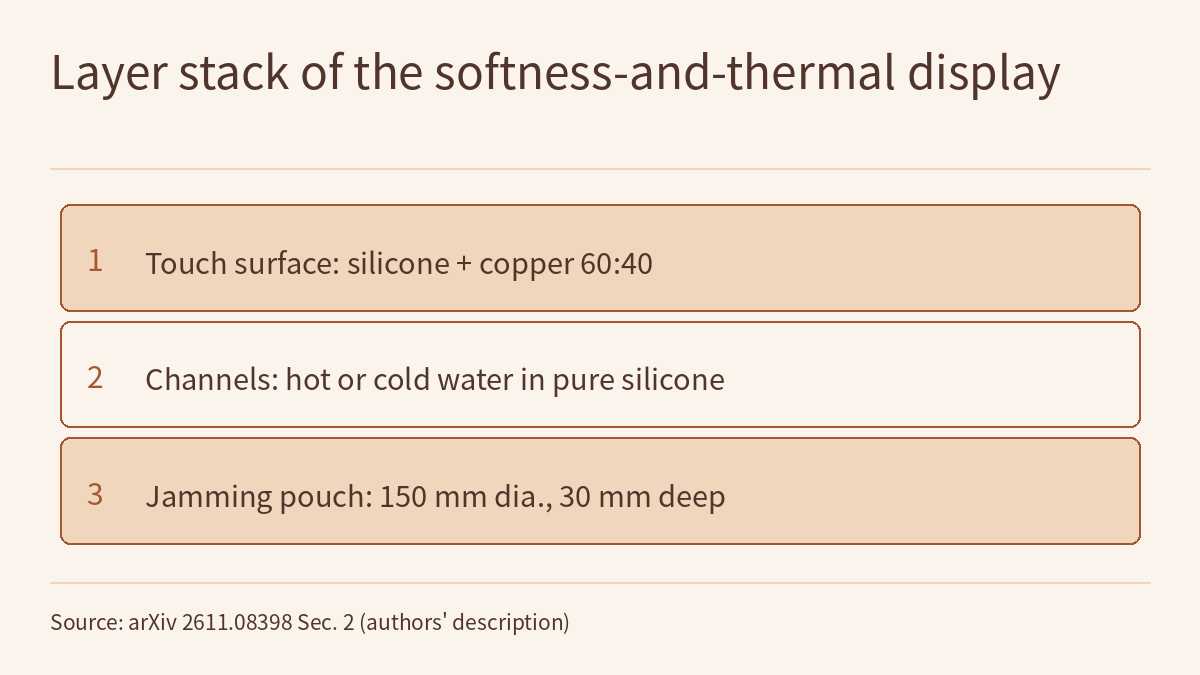
Softness layer. It follows the “constrictive” jamming from the authors’ earlier work: particles sit in a fabric pouch that is twisted from one end, which exerts radial forces on the particles in all directions and jams them. This version is circular, to address the uneven stiffness of the earlier design (harder in the centre than in the corners), and larger, at 150 mm in diameter and 30 mm deep, in a 3D-printed PLA frame. Because of the larger particle volume the authors chose a Maxon EC90 brushless DC motor with a nominal torque of 1.26 Nm, under closed-loop torque control by a Maxon EPOS4 70/15 controller.
Thermal layer. A thin silicone skin is attached to the top of the jamming container. The water channels are cast from Smooth-On Dragon Skin 10 FAST and joined to a touch surface made of Dragon Skin 10 FAST mixed with copper powder at 60:40 by mass. The copper layer conducts heat between neighbouring channels and between the water and the finger; the pure silicone below insulates the large thermal mass of the particles.
Temperature loop. Water temperature is set by a 100 W Peltier module with a 40 mm × 40 mm copper water block, and a CPU heatsink and fan on the other side remove excess heat during cooling. An Arduino Giga R1 WiFi reads 10 kΩ thermistors on the underside of the skin and runs a hybrid controller: bang-bang when the display temperature is more than ±5 °C from the setpoint, PID inside that band. The authors’ reason is that the thermal response is slow, and this reduces integration error.
Softness: how it was measured and what came out
The authors measured initial contact stiffness rather than bulk stiffness, for two reasons: measuring bulk stiffness needs a large contact force, and a large contact force itself changes the state of a jamming system; initial contact stiffness uses only small forces, so the effect of the silicone skin on the stiffness change shows up in the result. They used a digital force gauge with a 5 N capacity and a 20 Hz sampling rate, fitted with an 8 mm flat circular indenter and driven into the surface by a linear stage up to 4 N. Stiffness is the average slope of the force-displacement curve over 0.5–1 N, simulating a finger’s first contact.
- Unjammed (softest) state: average stiffness 0.63 N/mm, hysteresis 84%.
- Up to 0.5 Nm of torque, stiffness rises close to linearly and reaches 2.27 N/mm at 0.5 Nm, with 10.4% hysteresis.
- With more torque, stiffness barely changes and is 2.38 N/mm at the maximum of 1 Nm; hysteresis keeps falling roughly exponentially, to 2.1%.
The abstract states a “300%” stiffness increase. From the body’s 0.63 and 2.38 N/mm, this site calculates about 3.8 times, an increase of about 278%; the paper does not say how 300% was calculated. The body gives an average stiffness sensitivity of 0.00164 mm⁻² (the paper’s footnote: N/mm per N·mm). Calculating directly from the two endpoints at 0 and 0.5 Nm gives (2.27 − 0.63) / 500 N·mm ≈ 0.00328 mm⁻², twice the stated value, and the paper does not explain how its average was computed. Separately, the methods section says torque ran from 0 to 2 Nm in 0.2 Nm steps, while the results give a maximum torque of 1 Nm and the discussion covers only 0–1 Nm; the three passages disagree.
The authors explain the hysteresis this way: at low torque the particles underneath are still soft, so the silicone skin stores elastic energy when pressed in, which makes hysteresis high; they expect this to have a noticeable effect on tactile sensation.
Temperature: a wide range, but slow
Temperatures were measured at an ambient temperature of 20.7 °C. Heating at full Peltier power (open loop), the surface reached 50.2 °C within 20 minutes, with a thermal time constant τ = 290 s. With the polarity reversed for maximum cooling, it fell to 9.3 °C, τ = 325.5 s. Heating therefore reaches 29.5 °C above ambient, while cooling reaches only 11.4 °C below it (this site’s calculation). The test was run twice, with display temperatures within 2 °C of each other.
Uniformity was checked with a thermal camera at 120 × 160 resolution. During heating the surface was largely uniform: the difference between neighbouring channels was below 0.3 °C, and the area near the inlet was slightly warmer (below 2 °C). In the cold state the authors saw a slight difference between the two halves of the surface, but did not assess cold-state uniformity, citing the limited overall temperature change. At a surface temperature above 50 °C the outside of the particle pouch measured 26 °C, from which the authors conclude that little heat is lost to the particle layer.
The paper reports one closed-loop run. The surface was first heated to about 33 °C and then given a 15 °C setpoint. It took 12 minutes to reach the setpoint, an average fall of 1.5 °C per minute, and then stayed within ±0.2 °C of it for 15 minutes. During this test the monitoring system lost power at about 230 seconds and recovered at 620 seconds; the authors state that the relevant indicators were not affected. In every test there was a delay of about 30 seconds between sending a command and seeing the expected heating or cooling. The authors attribute it to the thermal inertia of the Peltier module and the water circuit. For applications that need faster hot-cold changes they suggest separate hot and cold water supplies, switched by target temperature, and they plan to shrink the display area to speed up the response.
How this relates to other pages on this site
Physical AI Lab 1.3 covers several kinds of robot sensors, among them force and touch sensors for sensing contact; this paper works in the opposite direction, presenting softness, warmth and cold to a human finger. The way to read the numbers is the same: 0.63 and 2.38 N/mm hold only for the 8 mm indenter, the 0.5–1 N range and this 150 mm display. They are not a general “material hardness” and do not map directly onto the softness a person perceives.
Physical AI Lab 1.2 explains that the PID integral term accumulates past error. The hybrid controller in this paper is worth reading against that: far from the setpoint it uses bang-bang, and only inside ±5 °C does it hand over to PID, which the authors say reduces the integration error caused by the slow thermal response. This site’s reading is that a large error lasting a long time would make the integral term accumulate too much, and bang-bang avoids that stretch; the paper does not elaborate on this. Lesson 1.2 is about how many times per second a loop runs; the roughly 30 seconds here is a different kind of time, the lag from command to response, and it also limits how quickly this display can present changes of warmth or cold.
Limitations
- This is an arXiv preprint. All numbers are author-reported [R], and this site has not reproduced them. The paper gives no public address for code, design files or data.
- All evaluation is by instruments; there were no human participants. A surface that reaches 9.3–50.2 °C and a stiffness that changes by about 3.8 times do not mean that people can tell these differences apart, or that a surface around 50 °C is suitable for prolonged contact. The paper does not discuss contact safety for this display.
- The abstract’s “300%” and “10–50 °C” are roundings or summaries of the body’s results, which give 0.63→2.38 N/mm and 9.3–50.2 °C. The inconsistencies in stiffness sensitivity and torque range are described above.
- The temperature test was repeated twice, and the paper reports one closed-loop run; the authors call this a preliminary evaluation that needs more in-depth testing. Recovery from perturbation was not tested. The discussion mentions temperatures achievable within a “2-minute response time”, but the body gives no corresponding data.
- Softness and temperature were measured separately. The body text this site read gives no data for adjusting both at once, and does not test whether the jamming state affects heat transfer or whether temperature affects stiffness.
- The authors consider the current system suitable for perceptual research and medical simulation, which do not need fast temperature changes. For interactive uses that need fast switching, the 30-second delay and a rate of change of about 1.5 °C per minute are the main limits at present.
Links
- A Multimodal Haptic Interface for Simultaneous Softness and Thermal Modulation (arXiv 2611.08398)
- Full text of the paper (HTML)
- Physical AI Lab 1.3: Sensors — Working Out Pixels, Depth Range and Grip Force for One Cup
- Physical AI Lab 1.2: PID and Control Rate — Computing the Three Terms by Hand, Then Turning Rates into Periods
- Physical AI Lab: a physical AI course where every number can be checked (course outline)


