
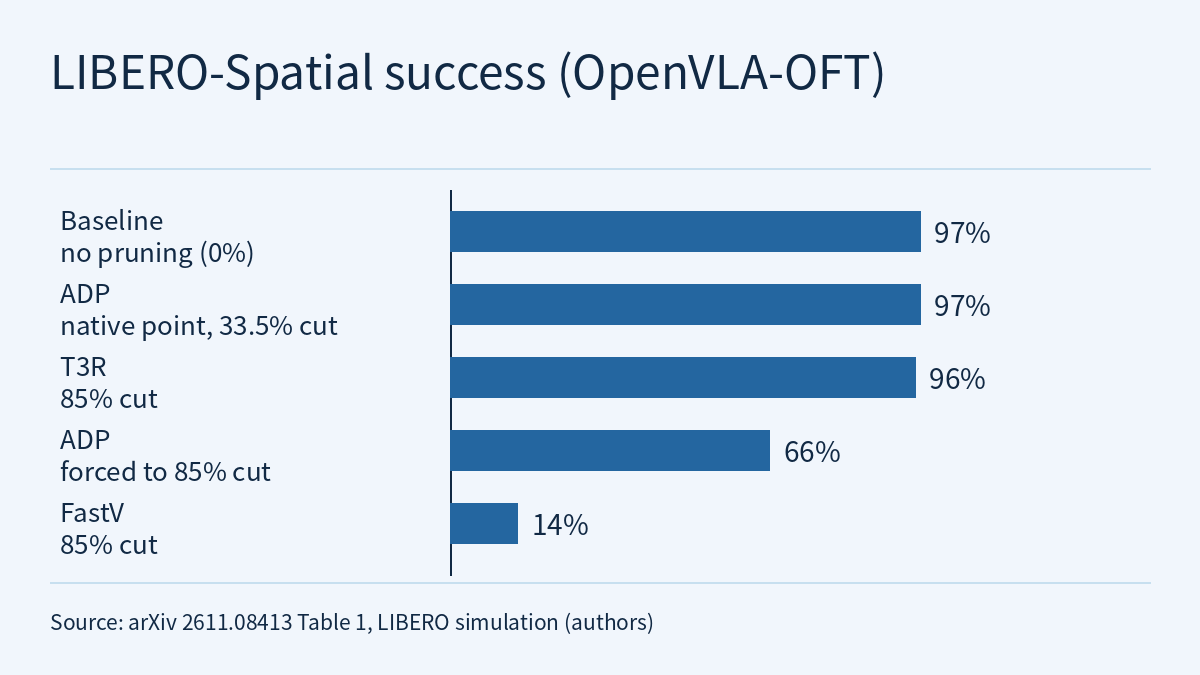
The preprint T3R: Training-Free Two-Stage Token Refinement Towards Efficient and Robust VLA Models (arXiv 2611.08413, 2026-11-05; authors from UT Austin, Georgia Tech, UIUC, the Hong Kong University of Science and Technology and UNC Chapel Hill; the page labels it an ASP-DAC ’27 paper) leaves the VLA untrained and does two things at inference time. First it uses a segmentation mask to remove image patches unrelated to the instruction before the visual tokens enter the language backbone. Then, in the middle layers, it adds a bias to the attention of the action tokens, steering it toward the retained target region and the key words of the instruction. The authors report that on LIBERO-Spatial, with 85% of OpenVLA-OFT’s scene-camera tokens removed, success is 96% (97% without pruning), and latency per call falls from 107.5 ms to 92.5 ms. All numbers below are reported by the authors [R]; this site has not reproduced them. Every experiment was run in simulation.
The problem: many visual tokens, most of them barely attended to
The paper takes an OpenVLA-style setup as its example: SigLIP splits a 224 × 224 image into 256 patches, one visual token each, and OpenVLA-OFT uses two cameras, so each call carries 512 visual tokens. This 256 is a count of image patches; it is unrelated to OpenVLA discretizing each action dimension into 256 bins, covered in Physical AI Lab 3.1. The authors measured how much attention the action-token queries give to visual tokens (averaged over 32 layers, 10 LIBERO-Spatial tasks and 3 timesteps per task): 93.9% of visual tokens each receive less than 0.2% of that attention, and in layers 24–31, 50–75% of tokens fall below 0.1%. The authors add that this only shows most tokens are near-inert; whether they can be removed safely at the decoder entry still depends on choosing the retained set well.
The authors split the redundancy into two kinds: many tokens are spatially irrelevant to the task, and among the rest, attention is often misallocated. Pruning alone discards critical cues, while steering attention alone keeps the full compute cost and the noisy input, so T3R prunes first and then adjusts attention only over the remaining sequence. This site’s 28 October article Frontier Radar | TRIAGE dealt with temporal redundancy across frames (reusing caches while they are still accurate); T3R deals with spatial redundancy within one frame, and the paper itself calls it complementary to caching methods such as VLA-Cache.
Stage 1: prune by segmentation mask, keep the original position IDs
- Scoring. SigLIP computes the cosine similarity between each word of the instruction and each image patch, averaged with part-of-speech weights: nouns and adjectives weigh more, verbs and prepositions less.
- Choosing prompt points. Similarity scores are often nearly flat, so taking the top K directly is unstable. The authors take the 50 highest-scoring patches, cluster their grid coordinates with DBSCAN (ε = 2.0, in patch units), keep only the largest cluster, take its 8 highest-scoring patches as positive prompts, and add the 3 lowest-scoring patches as negative prompts.
- Producing the mask. EfficientTAM-S generates an object mask from these points; a patch is kept if the mask covers more than 30% of its pixels, and the rest are removed. On suites where segmentation is ambiguous, patches above the 75th percentile of similarity can also be kept, trading a little compression for recall.
- No re-indexing. If the remaining tokens are renumbered in sequence after pruning, downstream tokens land on RoPE positions never seen in pretraining, and in the authors’ tests success fell to near zero. T3R lets every retained patch keep its original position ID. According to the position sequence the paper gives, the second camera’s 256 tokens (positions 257–512) are kept as they are; the reported removal rates refer to the scene camera only.
- Asynchronous updates. The SigLIP text embedding is cached per instruction; segmentation is updated asynchronously every 5 VLA calls (54 ms per update), and action inference uses the latest completed mask without waiting.
How much is removed varies by scene: 9–15 patches are kept in sparse scenes and up to 121 in clutter, whereas the baseline method TeamVLA keeps a fixed range of about 203–233. In the example of Figure 2 of the paper (“pick up the bowl between the plate and the ramekin”), T3R keeps only 13 of the 256 patches.
Stage 2: bias the attention of the action tokens
Pruning inevitably loses information, and the second stage compensates within the remaining sequence. At the start of each task, T3R computes Integrated Gradients over the instruction once, on the embedding layer (from a pad-token baseline to the actual input, 5 interpolation steps). The top 30% of words by attribution count as salient, and the result is cached and reused across all episodes of that task. T3R then adds an additive bias (strength β = 2.0) to the attention logits of layers 8–23, applied only to action-token queries. The biased positions are the salient words (weighted by their Integrated Gradients scores) and the retained image patches (weighted by SigLIP similarity times 0.5). Early and late layers are left alone; the authors’ reason is to avoid disturbing early feature extraction and late output formatting.
The ablation (LIBERO-Spatial, 10 tasks × 10 episodes) shows what each stage contributes: prune-only reaches 90%, bias-only 98%, both together 96%, against an unpruned baseline of 97%. Biasing recovers the 6 percentage points lost to pruning; the authors read bias-only exceeding the baseline as a sign that attention is diffuse without pruning. Biasing only the middle layers (8–23) reaches 98%, only early layers 95%, only late layers 92%, and all layers 93%.
Results: at the same 85% removal, success differs widely
The main study uses OpenVLA-OFT (SigLIP ViT-SO400M + LLaMA-2-7B, LoRA rank 32, action chunk length 8), 10 episodes per task, on a single NVIDIA L40S. Table 1 of the paper (LIBERO-Spatial):
| Method | Scene-camera tokens removed | Success rate | Latency per call |
|---|---|---|---|
| Baseline (no pruning) | 0% | 97% | 107.5 ms |
| TeamVLA | about 15% | 94% | 102.6 ms |
| FastV (k = 1, r = 0.85) | 85% | 14% | not reported |
| ADP (forced to 85%) | 85% | 66% | not reported |
| ADP (native operating point) | 33.5% | 97% | not reported |
| T3R | 85% | 96% | 92.5 ms |
The 85% rows for ADP and FastV come from the authors forcing them into T3R’s high-reduction regime; they are not those methods’ default settings. At its own native operating point (33.5%), ADP reaches 97%. So the table shows that at a reduction this aggressive, mask-based pruning at the decoder entry kept more of the success rate than the other two methods; it does not show that T3R is better than each method at that method’s own operating point.
Across the four LIBERO suites (10 tasks × 10 episodes each), T3R scores 96% against the baseline’s 97% on Spatial and 98% against 99% on Goal, at roughly 88–93 ms per call versus the baseline’s 105–108 ms. The Object suite is the exception: 82%, below TeamVLA’s 86%. The authors explain that these tasks place an object into a visually dominant container (for example, a basket), so similarity splits between the two and the segmenter picks the wrong region or produces too narrow a mask.
The out-of-distribution test adds Gaussian position noise to object placements (0–5 cm, 21 noise levels, 10 episodes per task). Under small perturbations T3R stays within 1–2 percentage points of the baseline; from 2 cm it matches or exceeds it, leading by up to 7 percentage points at 4 cm and by 4.8 points on average at 4 cm and above. At 5 cm TeamVLA reaches 35% and T3R 48%. The authors attribute this to pruning removing misleading background and to the attention refinement emphasizing task-relevant evidence; that explanation is consistent with the result, but the paper does not test the causal claim separately.
The latency account: what was measured and what was projected
- Measured at 224 px. Per call, 107.5 → 92.5 ms, a 14% reduction (1.16×). Each call produces an eight-action chunk, not one environment step. The language model alone goes from 58.9 to 36.1 ms; subtracting the two savings leaves 7.8 ms, which the authors attribute to the pruning and biasing themselves and which is already included in the 92.5 ms. The authors note that this accounting assumes comparable timing conditions and does not measure each component separately.
- Costs off the critical path. Segmentation takes 54 ms per update, once every 5 calls, and runs asynchronously. Integrated Gradients is computed once per task; the authors convert a 1 s cost over ten 220-step episodes into about 0.45 ms per environment step.
- Token count and time. Measured on the L40S at 11 token counts (8–256 patches), time is roughly linear: 0.040 ms per token + 53.3 ms (r = 0.97). The marginal cost is 0.040 ms per token at a sequence length of about 200 and rises to 0.064 ms at about 500; the authors read this as attention moving from a bandwidth-bound to a compute-bound regime.
- At higher resolution. Measured LLM-forward time is up to 3.3× faster (at 768 px). The end-to-end numbers are projections: adding a fixed 48.6 ms non-LLM cost to the measured LLM time gives 100 / 115 / 132 ms for T3R at 384 / 512 / 768 px, versus 144 / 182 / 327 ms for the baseline and 109 / 145 / 238 ms for ADP, a 2.47× speedup over the baseline at 768 px (ADP: 1.37×). The authors state that these projections do not separately measure the pruning and biasing overhead at each resolution.
At 224 px the measured gain is 14%, not the 3.3× in the abstract; the 3.3× applies only to the LLM forward pass at 768 px. Physical AI Lab 2.6 worked through “the rate ceiling is the inverse of one loop’s latency” and “saving size is not saving time”; the same care applies here. T3R shortens the language backbone’s sequence, but the segmentation model, the SigLIP scoring and Integrated Gradients have to be deployed in addition, and the text this site read does not report their memory use. The paper measures latency only on an L40S, with no energy measurements and no tests on edge devices.
Other backbones, other camera counts: little headroom with a single camera
The authors ported T3R to two other backbones. Both are zero-shot evaluations with no fine-tuned checkpoint, so absolute success rates are low:
- CogACT / SIMPLER (one third-person camera). On Google Robot (11 tasks, 189 episodes per method) the baseline reaches 73.2% and T3R (60% kept) 67.7%, 5.5 percentage points lower; on WidowX/Bridge (4 tasks, 96 episodes per method) both reach 10.4%. ADP and FastV, which keep more tokens, do better here. The authors’ explanation is that a single view carries little cross-camera redundancy, so aggressive pruning removes tokens the policy still needs.
- π0.5 / RoboTwin (three cameras). Each method and budget runs 5 tasks × 12 episodes = 60 episodes. At 50% kept, T3R and the baseline both reach 33.3%; at 62.5% kept, T3R reaches 38.3%, 5.0 percentage points above the baseline and 10 points above the best competing pruner. Over 60 episodes, 33.3% and 38.3% correspond to 20 and 23 successes (this site’s arithmetic).
From this the authors conclude that overlapping evidence from several cameras leaves more headroom for pruning. It is a trend across three systems in which backbone, benchmark and camera count all change at once; it is not a controlled experiment that varies only the camera count.
Limitations
- This is an arXiv preprint; every number is reported by the authors [R], and this site has not reproduced any of them. “The first training-free approach to prune 85% of scene-camera tokens before decoder entry while retaining success within 1 pp of the unpruned baseline” is the authors’ own positioning. The acknowledgements state that the research was supported by the NVIDIA Academic Grant Program. The text this site read does not mention a code release.
- All experiments are in simulation; the authors state that physical-robot control and asynchronous execution with real sensor and actuation delays remain unvalidated. Simulation results are not a hardware safety validation.
- Samples are small: each LIBERO suite has 100 episodes, so 96% against 97% is a difference of one episode, and the main success rates come without confidence intervals. Each RoboTwin cell has 60 episodes, so 5 percentage points equal 3 episodes. How an interval narrows with the number of trials is covered in Physical AI Lab 2.8.
- “85%” refers to the scene camera only; by the paper’s position sequence, the second camera’s tokens are kept as they are. If so, about 37 + 256 = 293 visual tokens enter the language model per T3R call (the authors say about 37 scene tokens are retained), roughly 57% of 512; this is this site’s inference.
- Pruning is irreversible. The mask is updated every 5 calls; if all 8 actions of each chunk are executed, about 40 environment steps in between use an old mask (this site’s inference). The failure cases the authors list include a source object competing for similarity with a visually dominant destination container (the Object suite); multi-phase tasks in which the relevant region shifts mid-episode while similarity is computed from the full instruction and does not adapt to the phase (the Long suite); the inherent failures of segmentation on merged or coarse boundaries; and occlusion and lighting changes that may make segmentation discard useful patches. The authors have not measured these effects separately or compared other segmenters.
- Integrated Gradients has a one-time cost per task that may not amortize over very short tasks or strict initialization deadlines. One hyperparameter set served all tasks; sweeping bias strength, active layers, salient-word ratio and pruning threshold changed success by 1–6 percentage points.
Links
- T3R: Training-Free Two-Stage Token Refinement Towards Efficient and Robust VLA Models (arXiv 2611.08413)
- Full text of the paper (HTML)
- Frontier Radar | TRIAGE: a VLA reuses the caches of visual tokens it does not recompute while they are still accurate, prunes them once stale, and fixes prefill latency with a fixed recomputation budget
- Physical AI Lab 3.1: Inside VLAs — Encoding One Cup Motion into 256-Bin Tokens, Then Labelling the Scope of Three Models’ Parameter Counts and Rates
- Physical AI Lab 2.6: To the Edge — Working Out the Control-Rate Ceiling from a Latency Log, Telling Whether Quantization Saves Size or Time, Then Sizing an Action Chunk
- Physical AI Lab 2.8: Reproducible Evaluation — Working Out Wald and Wilson Intervals by Hand, Sizing a Run from 1/√n, Then Bounding the Failure Rate after Zero Failures
- Frontier Radar deep dive | Edge and real-time: where the latency budget of VLAs and world action models goes


