
Lesson video
Narration is AI-generated. Video chapters, transcript and sources
Transcript
Transcript
UNIT-01 asks
For one robot to go on sale legally in Europe and in China, which years does it have to hit? In this episode, we put robot laws on one timeline, so you can see what's due in which year.
Laws for the AI brain
First, the laws on AI. The EU has an Artificial Intelligence Act. It sets rules for AI, and a timetable too. It entered into force on August first, twenty twenty-four. It phases in step by step. From August second, twenty twenty-six, most of its rules apply, and some high-risk rules come later. The first rules to apply were the bans. From February twenty twenty-five, a set of unacceptable uses was simply banned. Which ones? For example, AI social scoring of people, or secretly manipulating their choices. Unacceptable uses like these are simply not allowed. Another category is called high risk: hiring, credit, critical infrastructure. AI used there faces strict obligations before it goes on the market. Next come the rules for general-purpose AI models. From August twenty twenty-five, their obligations apply. Who enforces it? The EU set up an AI Office. It watches over large models, and can investigate and fine. One more is easy to miss. Companies that use AI must make sure their staff understand AI. This is the AI literacy obligation. Why is the EU so strict? Because it regulates AI as a product. If a product can hurt people, it has to prove it's safe first. Entry into force doesn't mean strict policing from day one. Guidance and enforcement come gradually. But the direction is clear. Breaking the rules is costly. At best, you fix things. At worst, fines or removal from sale. So don't treat compliance as optional. China is moving too. From September first, twenty twenty-five, its labelling measures apply. Service providers must label AI-generated content as the rules specify. Users who publish such content must declare it too. There are two kinds of label. One is visible, and tells you directly that AI made this. The other hides in the file, where machines can read it. This course follows that rule too. The opening states that the narration is AI-generated. So the law on AI doesn't come all at once. It arrives in batches, year by year!
Laws for the machine body
After AI, there's the machine itself. The EU has a new Machinery Regulation. It governs the safety of machines. It was adopted on June fourteenth, twenty twenty-three, giving industry a few years to adjust. The transition runs to January twentieth, twenty twenty-seven. From then on it's mandatory, replacing the old Machinery Directive. There's a rule for the transition. Machines placed on the market before January twentieth, twenty twenty-seven, still follow the old directive. Interestingly, this Machinery Regulation explicitly covers AI-driven safety functions. Here, the two lines start to cross. How does a machine show it's safe? With a CE mark. Putting it on is a declaration: I meet the EU's requirements. What's new compared with the old one? AI, and cybersecurity. And instruction manuals can now be digital. For higher-risk machines, the regulation sets out conformity assessment separately. Check which procedure applies to your machine's category. Don't assume the ordinary route. There's also a stack of paperwork: risk assessment, technical file, declaration of conformity. In an inspection, none can be missing. So how do you count as compliant? Through a set of harmonised standards. Follow them, and you're presumed to meet the law. Remember the division of labour. The law says it must be safe. Standards say how to make it safe. One sets the goal, the other gives the method. Many of these standards come from international bodies. Robot safety already has practices used around the world. So two lines govern robots: one for the AI, one for the machine!
Putting the timeline together
Let's line up the years. In twenty twenty-five, the AI prohibitions and the rules for large models came first. In September that same year, China's labelling measures took effect. Service providers, and users who publish the content, each have labelling duties. In August twenty twenty-six, most of the EU AI Act applies. Some high-risk rules come later. Note: that's when it applies, not when it entered into force. In January twenty twenty-seven, the Machinery Regulation becomes mandatory. From then on, machines newly placed on the market follow the new regulation. The last stop is August twenty twenty-eight. For high-risk AI built into machines, the transition ends and the rules start to apply. See it? The AI line and the machine line meet right in these years. So plan the compliance schedule for both lines together. What does this mean for exporters? The same robot must satisfy both lines, in several markets at once. Compliance isn't a pre-launch chore. It's scheduled from the design stage on. The later you fix it, the more it costs. One piece of advice for exporters. First, list the laws that apply in your target markets. Then plan backwards from the latest deadline. Regulatory dates can also shift. Don't assume a date is fixed; keep checking official updates. Those who comply early actually move more steadily. A reminder for the media. In compliance stories, don't confuse entry into force with the date a law applies. And don't treat a proposal as a law already in force. Don't forget other markets. The US takes a different approach. Rules differ from place to place, so check each market one by one. To investors, this timeline is a calendar. Each year a law starts to apply brings a wave of costs and opportunities. Still unsolved: standards often lag. Tech moves fast; laws and standards struggle to keep up. And countries haven't fully aligned yet. Let's recap, three points. One, two lines govern robots: one for AI, and one for machines. Two, in the key years from twenty twenty-five to twenty twenty-eight, the rules apply and become mandatory in stages. Three, compliance runs on harmonised standards, but standards lag, and countries don't agree. Keep the timeline in mind, and you'll understand compliance better than most! The rules are in place. But which use cases will work first? See you next time!
Evidence and sources
Practice and self-check
The quiz is public and explains each answer as you go; answers to the guide's exercises are for signed-in members.
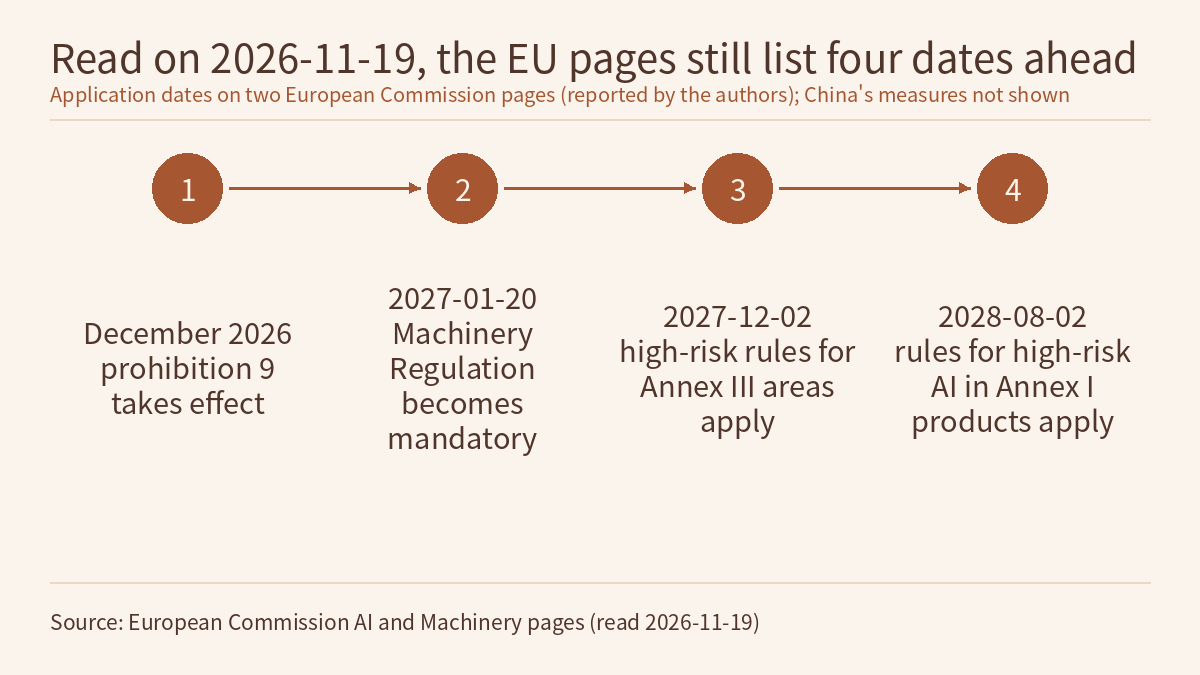
The video for episode 4.2 lays the rules that govern robots out on one timeline from 2024 to 2028. One line governs AI: the EU Artificial Intelligence Act (the AI Act below) applies in stages, and China’s Measures for Labelling AI-Generated Synthetic Content have applied since September 1, 2025. The other line governs machines: the EU Machinery Regulation applies on a mandatory basis from January 20, 2027 and explicitly covers AI-powered safety functions. Compliance runs on harmonised standards, but standards lag and countries do not yet agree. The dates in the video come from three official pages: the European Commission’s page on the regulatory framework for AI, the Commission’s Machinery page, and the full text of the labelling measures published by the Cyberspace Administration of China (CAC). This page is the reading guide and exercises for the episode. It does not repeat the transcript; it does three things the video concludes without working through. It pairs every date with the verb the source uses, separating adopted, entered into force, applicable and mandatory. It takes the video’s line that “some high-risk rules come later” back to the Commission page, where it is written as two dates, 2027-12-02 and 2028-08-02. And it reads what each line actually requires, then builds a compliance calendar for a fictional robot. The rule throughout: record a date together with its verb, its object, its source and the day you read it; if one of those is missing, the date cannot go into a schedule.
The video, transcript and sources for this lesson are at the top of this page; the season plan is in the course outline. The previous lesson, Physical AI Lab 4.1: Body and Supply Chain — Counting the G1’s 23 to 43 Joint Motors from Its Spec Table, Finding the Boundary Behind 40%–60%, Then Putting Three Prices Back on Their Own Terms, ended by asking: now the body is cheaper, which regulatory hurdles must it clear before going on sale? This lesson answers that. Building a timeline for a bundle of sources and filling in a status card were practised in Physical AI Lab 0.6: How to Judge Robot News — Tracing Each Question Back to a Sentence in the Source; how a technical safety function on a machine is designed and checked was covered in Physical AI Lab 2.7: Safety Filters — Working Out One Control-Barrier-Function Correction by Hand, Then Choosing Its Loop and Its Safety Margin. This lesson does not repeat those; it covers the three steps an L4 reader takes with compliance material: match the verb, check the date, separate the duties. The next episode, 4.3, asks which use cases work first.
The public five-question quiz comes with full explanations. After signing in you can work through three exercises: decide the applicable rules, dates and source sentences for four fictional products, and mark what the pages do not say; plan a fictional robot’s compliance schedule backwards from the latest deadline and see which part must be replanned after the high-risk dates moved; review six compliance statements in a fictional memo and rewrite them. Each comes with a step-by-step solution, common mistakes and a 20-point rubric.
1. Three official pages, and the version this lesson read
The European Commission’s Regulatory framework on AI page is the Commission’s explanatory page on the AI Act (Regulation (EU) 2024/1689). Under this course’s grading it is level O (official, first-hand). The bottom of the page reads Last update 19 October 2026; this lesson is based on the page text read on 2026-11-19. It is an explanatory page, not the legal text; this lesson did not read the full regulation or its annexes in the Official Journal.
The European Commission’s Machinery page covers the old Machinery Directive 2006/42/EC and the new Machinery Regulation (EU) 2023/1230. It is also level O and was read on the same day. The page states its own weight: the Commission’s services can only provide generic guidance on EU legislation, and only the Court of Justice of the European Union can give a binding legal interpretation.
The CAC page is a notice published on March 14, 2025, signed by four bodies, the Cyberspace Administration of China, the Ministry of Industry and Information Technology, the Ministry of Public Security and the National Radio and Television Administration, and dated March 7, 2025. It carries the full 14 articles of the Measures for Labelling AI-Generated Synthetic Content (in Chinese) and is level O.
The table below shows how far each source reaches. The “Not on the page” column is this lesson’s own summary; it is the column people most often fill in for themselves when building a schedule:
| Source | Level | What this lesson uses | Not on the page |
|---|---|---|---|
| Commission AI framework page | O | Application timeline, four risk levels, examples of high-risk uses, the progress of the AI Omnibus | The full lists in Annex I and Annex III; whether a given product is high-risk |
| Commission Machinery page | O | Adoption and mandatory dates, transition rule, the points listed for the new regulation, notes on CE marking and certificates | Which conformity assessment procedure a given category of machine follows; the numbers of specific harmonised standards |
| CAC labelling measures | O | Date of effect; the duties of service providers, distribution platforms and users | The text of the three regulations Article 2 refers to; whether a specific service falls within the measures |
Sign in to keep reading: the rest of this lesson, its self-check questions and the answers.
Limitations
- All three sources are level O. The two European Commission pages are explanatory pages, not legal texts; this lesson is based on the page text read on 2026-11-19, and the AI page shows its last update as October 19, 2026. The Machinery page itself states that the Commission can only give generic guidance and only the Court of Justice of the European Union can give a binding interpretation.
- This lesson did not read the texts or annexes of the AI Act or the Machinery Regulation, nor the three regulations cited in Article 2 of the labelling measures. It draws no conclusion on whether a robot’s AI function is high-risk AI in an Annex I product, which conformity assessment procedure a category of machine follows, or whether a service falls within the labelling measures.
- The video’s number card puts high-risk AI built into machines on 2028-08-02. The Commission page’s product examples are lifts and toys; it says the relationship between the AI Act and the Machinery Regulation has been clarified but does not set out the details.
- For the item in the Commission page’s ‘Policy and legislation’ list about the first harmonised standard supporting the AI Act, this lesson read only the title and did not open it, so no standard number is given.
- Dates on the pages change with legislation; 2027-12-02 and 2028-08-02 are themselves the result of the AI Omnibus amendment. Read the page again and note the reading date before citing them.
- The example robot M, products A-1 to F-6, M2, M2-L, memo statements S1–S6 and all their dates and durations are fictional. Paper planning is not legal advice, nor a conformity assessment or a hardware safety validation.
Links
- Physical AI Lab: a physical AI course where every number can be checked (course outline)
- Physical AI Lab 4.1: Body and Supply Chain — Counting the G1’s 23 to 43 Joint Motors from Its Spec Table, Finding the Boundary Behind 40%–60%, Then Putting Three Prices Back on Their Own Terms
- Physical AI Lab 0.6: How to Judge Robot News — Tracing Each Question Back to a Sentence in the Source
- Physical AI Lab 2.7: Safety Filters — Working Out One Control-Barrier-Function Correction by Hand, Then Choosing Its Loop and Its Safety Margin
- European Commission: Regulatory framework on AI (AI Act application timeline and the AI Omnibus)
- European Commission: Machinery (Machinery Regulation (EU) 2023/1230 and Machinery Directive 2006/42/EC)
- Cyberspace Administration of China: notice issuing the Measures for Labelling AI-Generated Synthetic Content (in effect from 2025-09-01, in Chinese)