Lesson video
Narration is AI-generated. Video chapters, transcript and sources
Transcript
Transcript
UNIT-01 asks
A piece of robot news: how can you tell at a glance whether it holds up? This episode gives you a method: first check who said it, then ask four more questions. Every day there's a flood of robot news online, true and false mixed together. Learn this method, and you can sift it yourself.
First, who said it
Sort sources into three levels. Official and first-hand is O. Papers and preprints are R. Media, second-hand, is M. The same news, told by the company, by a paper, or retold by the media, carries different weight. The closer to first-hand, the easier it is to check. But discount what a company says about itself, and look for outside verification. Take one item from the radar snapshot. According to Japanese media reports, Daifuku plans a field trial in 2030. This one is M, second-hand, so check the original. And note: it's a planned demonstration, not robots already working in a warehouse.
Then four more questions
Question two: is it a demo, or already at work? Pilots and field trials are all still just trials. Questions three and four: success at what? Peak, or usual? One paper reports, versus standard batch evaluation, up to seventy percent less evaluation work. Note: that seventy percent is effort saved on evaluation, not the robot's success rate at work. And it's the maximum, not every time. Another tip: look for checkable facts, beyond adjectives. Ask what a number measures and under which conditions. If output is not disclosed, do not invent it. Question five: is there a time-specific primary source? Tesla's second-quarter 2026 update lists the Optimus lines as under construction. Check the reporting period; it does not establish status at publication time. Suppose a monthly output figure goes around online, but it isn't in the official release. Then don't take it seriously yet. So with any number, first ask: success at what, and is it the peak or the usual?
Five practice items
Your turn. Open the radar snapshot, pick five items, and ask each one these five questions. Getting the level wrong, taking a demo for deployment, taking the peak for the usual: each will make you overrate it. Let's recap three points. First, ask who says it: O, R, M. Second, ask four more questions: demo or deployment, success rate, peak or typical, and source. Third, do not invent undisclosed data. Know these few questions, and you're more reliable than lots of people who just repost! Next time, we go into the lab and get a robot arm to reach the cup on the table. See you next time!
Evidence and sources
Practice and self-check
The quiz is public and explains each answer as you go; answers to the guide's exercises are for signed-in members.
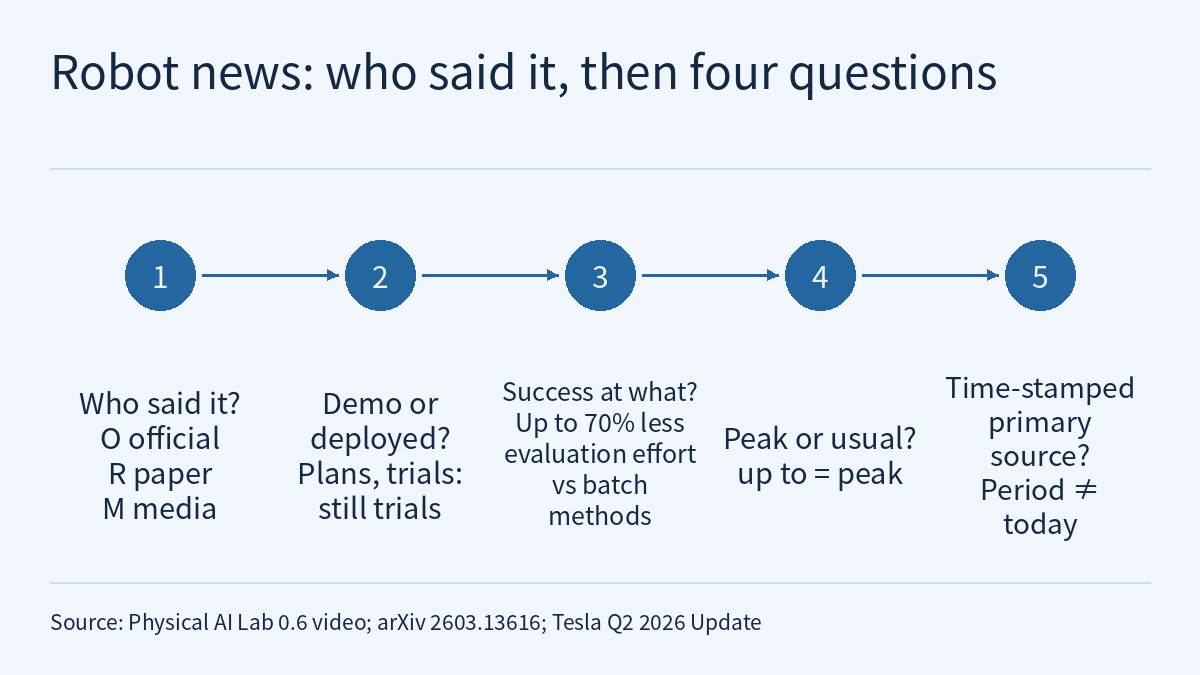
The episode 0.6 video gives a method for reading robot news: first check who said it (O official and first-hand, R paper or preprint, M media, second-hand), then ask four more questions: is it a demo or already deployed, success at what, peak or usual, and is there a time-specific primary source? The video uses three real pieces of evidence: Daifuku’s plan for a field trial in 2030, as collected by the radar (M); a preprint’s “up to 70% less evaluation work” (R); and page 6 of Tesla’s Q2 2026 update on the Optimus production lines (O). This page is the episode’s reading and exercise companion. It does not repeat the transcript. Instead it traces each question back to a sentence in the source, with extra practice on question five: one document often carries several dates, and the reporting period, the publication date and today’s status have to be checked separately. If the source does not disclose a number, write “not stated in the source” and do not fill it in yourself.
This lesson was updated along with the revised video: the previous edition used XPeng’s press release as the example for question five; this edition uses Tesla’s quarterly update instead. The video, transcript and sources for this lesson are above on this page; the whole season is in the course outline. The previous lesson, Physical AI Lab 0.5: The Humanoid Robot Boom — Sorting One Passage of Tesla’s Quarterly Update into Demo, Prototype, Production and the Job, already sorted Tesla’s passage clause by clause into done, under way, expected and planned. This lesson does not repeat that; it uses the passage only to practise dates and undisclosed numbers. Where the O/R/M levels come from is explained in Physical AI Radar: an embodied AI morning brief with an evidence level on every item.
The public five-question quiz comes with full explanations. Sign in for three exercises: trace how a fictional number changes across four retellings, put a fictional source pack on a timeline and fill in a status card, and review four fictional paper headlines, each with a worked solution, common mistakes and a 20-point rubric.
1. The five-question card: which sentence to look for
The video’s five questions fit on one card. The second column is how to apply each question, which is this lesson’s teaching suggestion; the third column is the example from the video.
| Question | What to look for in the source | Example from this episode |
|---|---|---|
| 1. Who said it? | Who published it: the company about itself, the paper’s authors, or the media retelling it | The Daifuku item, marked M by the radar, from a MONOist (ITmedia) report |
| 2. Demo or already deployed? | The tense of the sentence: plan, pilot, field trial, or already running | Daifuku plans a field trial in 2030: a future trial, not robots already working in a warehouse |
| 3. Success at what? | What the number is about: which task, which metric, which conditions | The “70%” is a reduction in evaluation work, not the robot’s success rate at a task |
| 4. Peak or usual? | Words such as up to, maximum, at most, and what it is compared with | Up to 70% less than standard batch evaluation methods |
| 5. A time-specific primary source? | Which date or period the source refers to, and whether the number you want to cite is actually in it | Tesla’s Q2 2026 update lists the Optimus lines as Construction; that is the status for the reporting period, not today’s status |
The video adds a tip: look for checkable facts, beyond adjectives; ask what a number measures and under which conditions; if output is not disclosed, do not invent it. Answer all five questions first, then decide whether and how to repeat the claim.
Sign in to keep reading: the rest of this lesson, its self-check questions and the answers.
Limitations
- Tesla’s Q2 2026 Update is level O; the line progress, expectations and planned uses are all self-reported by the company, and this site has not verified them independently. The reporting period ends on 2026-06-30; the supplied text gives no publication date. This lesson does not track later progress and does not infer current output, deliveries at scale or long-term reliable work. It relies on the report’s text, not its images or charts.
- Beyond Binary Success (arXiv 2603.13616) is a preprint, level R; the 70%, the 50%, the rollout counts and “no loss of statistical rigor” are all reported by the authors, and this site has not reproduced them. This lesson relies on the abstract and the first sections of the paper, not the supplementary material.
- The Daifuku item relies only on the headline, excerpt and analysis collected by the radar; this lesson did not read the original MONOist article. The radar’s analysis is drafted by AI and not reviewed by a human.
- The circulating monthly output figure, the 100 and 30 runs in section 3 and the start-up news in section 4 are hypotheticals for practice. They are not data from any company, team or system, and they do not imply that such claims exist online. The model summary in section 2 was written for this lesson and is not text from the report.
- In section 5, the fictional companies K and Q, team V, method X and every date, count, success rate and “500 units a month” are invented for practice; 61.7%, 61.5%, 53.5%, 80%, 85.5% and the other results hold only under those assumptions. The simulation results in task 3 are fictional, and simulation results are not a hardware safety validation. The date categories, status card fields, the “usable / needs rewriting / unusable” sorting and the rubrics are teaching suggestions, not definitions or conclusions from any source.
- The five-question card is a checklist to support judgement; it does not guarantee a correct conclusion. Being able to find a first-hand source means the claim can be checked, not that the source is necessarily right.
Links
- Physical AI Lab: a physical AI course where every number can be checked (course outline)
- Physical AI Lab 0.5: The Humanoid Robot Boom — Sorting One Passage of Tesla’s Quarterly Update into Demo, Prototype, Production and the Job
- Physical AI Radar: an embodied AI morning brief with an evidence level on every item
- Frontier Radar | Beyond Binary Success: sequential tests that separate robot policies with fewer real-world rollouts
- Physical AI Radar (every item marked O/R/M, with original links)
- Physical AI Radar · 2026-09-28 (the items used in this episode’s practice; Chinese edition)
- Beyond Binary Success: Sample-Efficient and Statistically Rigorous Robot Policy Comparison (arXiv 2603.13616)
- Tesla: Q2 2026 Update (page 6, Robotics section and capacity table; reporting period ends 2026-06-30)