Lesson video
Narration is AI-generated. Video chapters, transcript and sources
Transcript
Transcript
UNIT-01 asks
The humanoid robots in videos can dance and do backflips. So why isn't one working in your home or factory yet? This episode, we tell three things apart: demo, prototype, and mass production. From demo to mass production, there's still a long road.
Demo
First, demos. One industry analysis says the robot videos flooding your feed are often, after many tries, the best one. Folding clothes, say, or twisting off a bottle cap. When it looks great in the video, it was usually picked from many tries: the best one. And some demos that look fully automatic actually have a person remote-controlling them behind the scenes. The same analysis says this isn't rare. A demo tells you the best it can do. It doesn't tell you, on a normal day, how many tries out of ten succeed. So a demo is its best take, not what it does every day!
Prototype and mass production
A prototype can do it once, in the lab. Mass production means consistently building many units that are all the same. Consider Tesla's Optimus humanoid. Its second-quarter 2026 update says first-generation production lines are being installed. The report says initial builds will collect training data and support further development. That is a planned use, not proof of large-scale delivery or reliable long-term work. But even with mass production, working for the long haul still means a big hurdle, called reliability. One industry analysis says industrial lines seek ninety-five percent uptime or more. It also says most humanoid robots work thirty to ninety minutes at a stretch. These are different metrics, with no direct conversion, and not measurements of every robot model. Being able to demo it, and to build a prototype, is real skill. But to show up for work every day, there's a lot more practice ahead.
How to read a news story
Once you can tell demo, prototype and mass production apart, you also need to ask, of any line in the news: who said it? Here's a simple method: sort evidence into three levels. Official and first-hand, academic research, and media, second-hand. What makers say about themselves, discount it first. Once there is independent validation, real use in factories and reliable long-term work, it's not too late to take it seriously. Let's recap three points. One: a demo shows the best take, not the usual result. Two: preparing a line does not prove reliable long-term work. Three: ask who is making the claim. So when an amazing robot video pops up, don't jump to conclusions! So how do you actually judge whether a robot news story holds up? Next time, we'll practice five questions with this radar snapshot!
Evidence and sources
Practice and self-check
The quiz is public and explains each answer as you go; answers to the guide's exercises are for signed-in members.
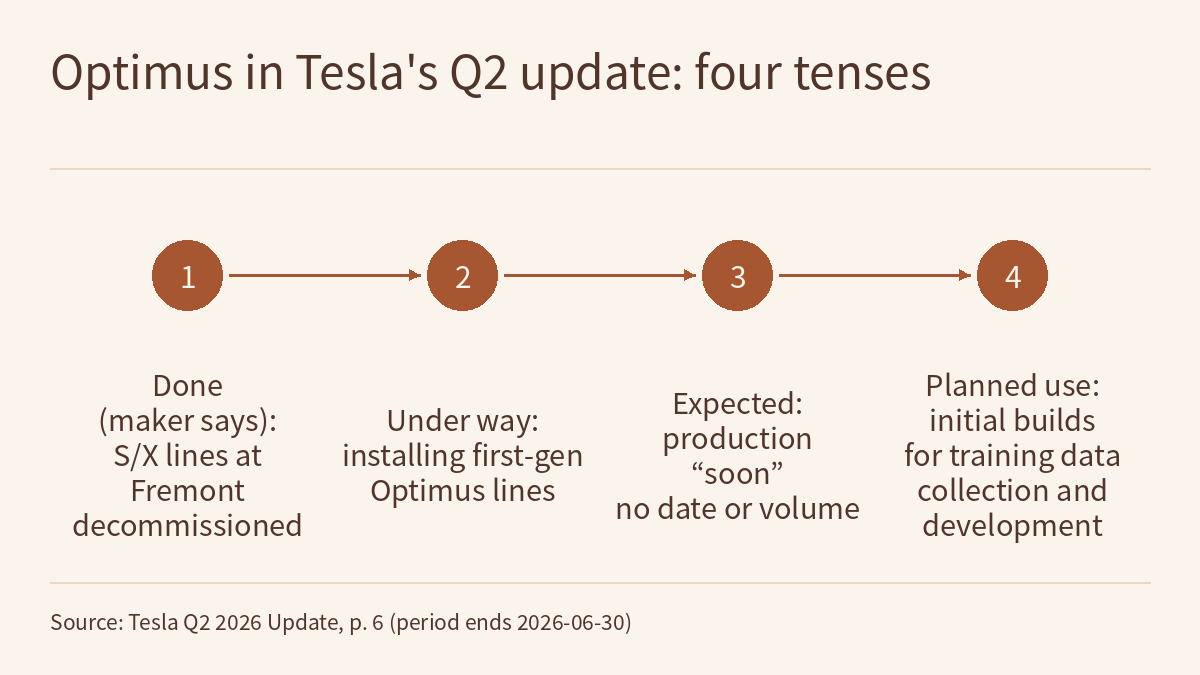
The episode 0.5 video explains the humanoid robot boom as a set of steps: a demo is often the best of many tries, a prototype can do something once in the lab, and mass production means consistently building many identical units; and even with mass production, working on the job for the long haul still means clearing the hurdle of reliability. The video’s “prototype and mass production” chapter uses page 6 of Tesla’s Q2 2026 update as its example: first-generation Optimus production lines are being installed, and the initial robots are planned for training data collection and further functionality development. This page is the episode’s reading and exercises. Rather than repeat the transcript, it takes the report’s statements about Optimus one at a time, sorts each as done, under way, expected or planned, separates the reporting period from today, explains why “uptime” in the two sources is not the same metric, and then practises the method on a hypothetical paraphrase. One rule runs through all of it: a statement proves only the step, and the point in time, it actually talks about.
This lesson has been updated with the revised video: the previous edition’s production-line example was an XPeng press release, and this edition uses Tesla’s quarterly update instead. The video, transcript and sources are at the top of this page; for the season plan, see the course outline. The previous lesson, Physical AI Lab 0.4: Ten Thousand Tries in a Virtual World — Putting the Conditions Back on Three Simulation Numbers, ended by asking: everyone says humanoid robots are coming, but what separates a demo, a prototype and mass production? This lesson picks up from there. For where the video’s O/R/M evidence levels come from, see Physical AI Radar: an embodied AI morning brief with an evidence level on every item.
The public five-question quiz comes with full explanations. Sign in for three exercises: split a fictional demo log into the best take and the usual result, compute the operating share of one fictional shift under three conventions and review three statements about it, and review a fictional purchasing memo that treats a demo, shipments and one trial as proof of reliable work, each with a worked solution, common mistakes and a 20-point rubric.
1. Four steps, and what each one shows
The video promises to tell three things apart: demo, prototype and mass production. At the end of chapter two it adds a hurdle after mass production: to work for the long haul, a robot still has to clear “reliability”. The table below lists “on the job for the long haul”, the step beyond that hurdle, as a step of its own, so that each statement can be placed on it later.
| Step | What the video says | What this step shows | What it does not yet show |
|---|---|---|---|
| Demo | Often the best of many tries; some that look fully automatic have a person remote-controlling them behind the scenes | The task has succeeded at least once | How many tries out of ten succeed on a normal day; whether it was fully autonomous at the time |
| Prototype | Can do it once, in the lab | The design can be built and made to move | Whether many identical units can be built consistently |
| Mass production | Consistently building many units that are all the same | Manufacturing consistency | Whether the robots run reliably for the long haul once on the job |
| On the job for the long haul | The “reliability” hurdle that remains after mass production | Metrics such as uptime share and continuous runtime per session need separate validation | The video’s reliability evidence is an overall statement in an industry analysis, not a measurement of any particular model |
The episode also avoids saying “you can’t buy one”: some humanoid robots already have a listed price, and the cited industry analysis lists the Unitree G1 as starting at US$13,500 (level M). Being able to buy one or demo one is a different matter from being able to work reliably every day.
Sign in to keep reading: the rest of this lesson, its self-check questions and the answers.
Limitations
- Tesla’s Q2 2026 Update is level O; its line progress, expectations and planned uses are the maker’s own claims, and this site has not independently verified them. The reporting period ends on 2026-06-30; this page does not track later progress and does not infer current output or deliveries.
- This lesson is based on the report’s text, not on its photos or the visual content of its charts.
- RoboZaps’ Challenges in Humanoid Robotics (2026-01-30) is an overall analysis on an industry blog, level M. The supplied text does not say how uptime is calculated, it is not a measured benchmark for each model, and the 4–5 hours for Optimus Gen 2 is an estimate the article cites from elsewhere.
- The two robots in section 3 and the paraphrase in section 4 are assumptions for the exercises; 66.7% and 95.2% are divisions based on those assumptions, not the performance of any system.
- Robots H and R, the fictional company M and all the logs, times, unit counts, success rates and uptime figures in section 5 are invented for the exercises; 60%, 41.7%, 78.1%, 89.3%, 91.7%, 92.7% and the rest hold only under those assumptions. Conventions A, B and C and the alternative recommendation in section 5 are teaching suggestions, not definitions or conclusions from RoboZaps or Tesla; paper calculations and a single trial are not hardware safety validation.
- The four steps are a framework to aid understanding; in practice R&D, manufacturing and pilots often overlap and do not necessarily happen strictly in sequence.
Links
- Physical AI Lab: a physical AI course where every number can be checked (course outline)
- Physical AI Lab 0.4: Ten Thousand Tries in a Virtual World — Putting the Conditions Back on Three Simulation Numbers
- Physical AI Lab 0.6: How to Judge Robot News — Tracing Each Question Back to a Sentence in the Source
- Physical AI Radar: an embodied AI morning brief with an evidence level on every item
- Physical AI Radar (O/R/M evidence levels)
- Tesla: Q2 2026 Update (page 6 Robotics section and capacity table; reporting period ends 2026-06-30)
- RoboZaps: Challenges in Humanoid Robotics (2026-01-30)