Lesson video
Narration is AI-generated. Video chapters, transcript and sources
Transcript
Transcript
UNIT-01 asks
To knock over a stack of blocks, why push it in a computer first? Last time left a question: how do robots practise in a virtual world? This episode, we answer it. What simulation really is, and why robots can't do without it.
What simulation is
Simulation means building a fake world inside a computer. It has gravity, a table, and blocks, all calculated by real physics. Give the blocks a push. How they fall, and where they land, the computer works out step by step. A program like this is called a physics engine. The same scene can be knocked down and reset, then knocked down and reset again. Simulators like MuJoCo and Isaac are built for exactly this. So before the blocks really fall, they've already fallen many times in the computer!
Why practise in a virtual world
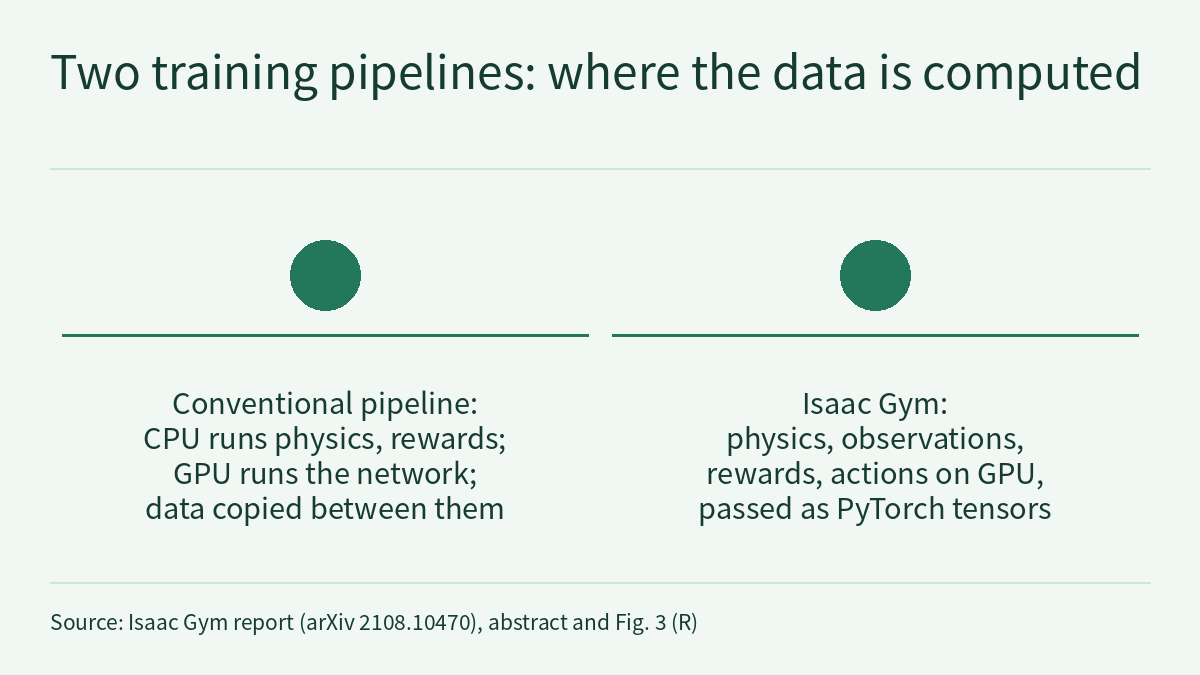
The first benefit is safety. One fall, and a real robot may break. In a virtual world, it can fall as often as it likes, and nobody minds. The second benefit is speed. A real robot practises one run at a time. In one paper, several thousand robots practised together inside a computer. The paper says that this way, in under four minutes, it learns to walk. It's a four-legged robot, on flat ground. A technical report says that moving simulation onto graphics cards made it a hundred to a thousand times faster than the old way. What it saves is a huge amount of time. So in a computer, practice goes way faster than on a real robot!
Is simulation real enough?
But however lifelike a simulation is, it isn't real. A real table is a little slippery, real blocks are a little crooked, and the simulation may not have that. So however well it trains in the virtual world, moving to a real robot often still needs some tuning. We'll give this step its own episode later. Let's recap, three points. One, simulation is a fake world in a computer, calculated by physics. Two, the upside: it's safe, it's fast, and many can practise together. Three, the downside: it isn't quite the same as reality. So the virtual world is the training hall, but the final exam is in the real world! Everyone says humanoid robots are coming. But demo, prototype, mass production: what's the difference? See you next time!
Evidence and sources
Practice and self-check
The quiz is public and explains each answer as you go; answers to the guide's exercises are for signed-in members.
The episode 0.4 video explains simulation with a stack of blocks being knocked over: a “fake world” computed in a computer by the laws of physics, safe, fast and able to train many robots at once, yet not quite the same as reality. Three numbers appear in the video: thousands of robots practising together, learning to walk in under four minutes, and simulation on graphics cards running a hundred to a thousand times faster. This page is the episode’s reading and exercises. Rather than repeat the transcript, it puts each of the three numbers back into the experimental conditions of its own paper, explains what “moving onto the graphics card” actually removes, and works through the batch size of parallel training by hand with a set of hypothetical numbers. One rule runs through all of it: a number holds only for the paper, the hardware and the task that produced it.
The video, transcript and sources for this lesson are at the top of this page; for the season plan, see the course outline. The previous lesson, Physical AI Lab 0.3: See, Think, Act — Putting Each Rate Back in Its Own System, ended by asking: experiments on real robots alone are slow and costly, so can we try things in a virtual world first? This lesson picks up from there.
The five public quiz questions come with full explanations. Signed-in readers can work through three exercises: choose a parallel training set-up for a fictional quadruped under fictional constraints, keep three kinds of time in a fictional training log on separate accounts and review four paraphrases, and review a fictional plan to move a block-pushing policy straight onto a real robot, each checked against a step-by-step solution, common mistakes and a 20-point rubric.
1. Three numbers, each with its own conditions
The three numbers come from two arXiv documents from 2021, and all are author-reported (level R). Both author teams have NVIDIA ties: the Isaac Gym technical report lists NVIDIA as the authors’ affiliation, and the authors of Learning to Walk in Minutes are from ETH Zurich and NVIDIA. The “What it does not say” column in the table below matters just as much.
| In the video | Source | Conditions in the original | What it does not say |
|---|---|---|---|
| Thousands of robots practising together | Rudin et al., Learning to Walk in Minutes (arXiv 2109.11978, 2021-09-24) | “Thousands” of simulated robots training in parallel with Isaac Gym on a single workstation GPU; the paper’s Figure 3 shows 4,000 robots | The abstract says only “thousands”; it is not a fixed upper limit |
| Learning to walk in under four minutes | Same | A flat-terrain policy for the four-legged robot ANYmal trains in under 4 minutes; uneven terrain takes about 20 minutes | This is training time in simulation, not the time the robot spends learning on real ground |
| A hundred to a thousand times faster | Makoviychuk et al., Isaac Gym (arXiv 2108.10470, 2021-08-24) | With both physics simulation and neural-network training on a single GPU, 2–3 orders of magnitude faster than conventional RL training with a CPU simulator and GPU neural networks; Figure 2 puts it as 100–1000x for the overall RL training pipeline | Not that every task speeds up this much, and not a comparison with training on real robots |
One robot, two times. The Isaac Gym report also gives a number for ANYmal: performant locomotion “in under 2 minutes” on a single NVIDIA A100. The Rudin paper says “under four minutes” on flat terrain on a single workstation GPU. The two statements differ in hardware and task setup, and the excerpts provided do not compare them under the same conditions, so you cannot conclude which is faster, or that “the A100 is twice as fast”.
Sign in to keep reading: the rest of this lesson, its self-check questions and the answers.
Limitations
- The numbers from Learning to Walk in Minutes (arXiv, 2021-09-24) and Isaac Gym (arXiv, 2021-08-24) are author-reported, level R. Both documents have NVIDIA authors: the Isaac Gym report is affiliated with NVIDIA, and Learning to Walk in Minutes has authors from ETH Zurich and NVIDIA; Isaac Gym is an NVIDIA product. This site has not independently reproduced any of them.
- This lesson relies on the abstracts and excerpts of the first sections of the two documents, not their supplementary material; the results of real-robot transfer do not appear in this text.
- The 4,000 robots, 128 environments, 2,000 s and 782 steps in section 4 are assumptions or derived figures for the exercise, not the configuration or performance of any system; the 30x and under-3x factors in step 5 are this lesson’s division of the report’s numbers, and the report itself does not state these factors.
- In section 6, robots Q and P, team K, the 24-step minimum, the 50-step cap, the 50,000–100,000 batch range, all logs, friction coefficients, block sizes, camera offsets, masses and the 98% success rate are fictional, for the exercises only; computed figures such as 1,966,080 s and about 2,185x hold only under these assumptions. The randomization ranges and real-robot checks in section 6 are teaching suggestions, not conclusions from the sources; neither paper calculations nor simulation results are hardware safety validation.
- “Knocking over blocks” and “training hall and exam” in the video are analogies to aid understanding. The block example is not an experiment from either document.
Links
- Physical AI Lab: a physical AI course where every number can be checked (course outline)
- Physical AI Lab 0.3: See, Think, Act — Putting Each Rate Back in Its Own System
- Physical AI Lab 1.4: A Map of Simulators — Counting the Cost of the Timestep, Finding Where Contact Splits Two Runs, and Pinning Three Speed-ups to Their Baselines (continues in L1 with timesteps, contact and another speed-up figure)
- Frontier Radar | VLaRL: a frozen VLA, residual RL trained only in simulation, and VLM latents to bridge the visual sim-to-real gap
- Learning to Walk in Minutes Using Massively Parallel Deep Reinforcement Learning (arXiv 2109.11978)
- Isaac Gym: High Performance GPU-Based Physics Simulation For Robot Learning (arXiv 2108.10470)