
Lesson video
Narration is AI-generated. Video chapters, transcript and sources
Transcript
Transcript
UNIT-01 asks
The most expensive part of a humanoid robot often isn't its brain. So what is it? This time, a different angle. We won't look at the model. We'll look at the body. Actuators, materials, cost, one by one.
The body is a pile of actuators
First, actuators. They're the robot's joint motors. An actuator is a motor plus a gearbox. Add sensors and control. One robot carries dozens of actuators. Unitree says its G1 has twenty-three to forty-three joint motors. An industry report looks across humanoid robots. It says a humanoid has twenty-eight to forty-four actuators. How they're spread out depends on the configuration. The ones in the legs hold up the whole body. The arms and hands do the fine work. Rotary joints are common among these actuators. Arms and necks turn on them. Some places use linear actuators, like some knees and ankles. Why are actuators so important? They have to be strong and precise. And light, small, and durable too. The joints must be accurate. Off by a little, and the cup is grabbed wrong. So encoders and control can't be skipped. Hands above all. A dexterous hand is full of small actuators. The more fingers, and the more nimble, the more actuators. One trend is to make actuators standard modules. Like building blocks, they fit different robots. That spreads out the cost of R&D and purchasing. So don't underestimate an actuator. It's a precision assembly. Motor, gearbox, encoder, driver, and cooling. Every one is needed. Joints also need to sense force. A finger pressing a cup. Too loose and it drops. Too tight and it cracks. That sense of touch comes from actuators too. So a robot is, first of all, a pile of joints that move!
Where the money goes: the bill of materials
To build a robot, you first write a bill of materials. In the trade, it's called the BOM. Every part and every price goes on it. So where does most of the money go? The same report says actuators are about forty to sixty percent of the material cost. That's a large slice. The rest is split among compute, other sensors, structural parts and more. So in one line. To understand body cost, look at the actuators first. That explains something. To make the whole robot cheap, saving on chips alone has a limited effect. Every actuator has to get cheaper. And don't mix up two prices. One is the parts cost estimated from a teardown. The other is the real cost in mass production. They may differ quite a bit. The gearbox is one of the hard parts. It must be precise, wear-resistant, and have no play. If yields don't go up, prices won't come down. Then there are structural parts, the robot's skeleton. It must be light, but strong. A bit lighter, and the motors work less hard. So a large share of a robot's cost goes into its joint actuators!
The cost curve and the supply chain
First, the prices. In earlier years, humanoids that could walk and move mostly stayed in the lab. The prices were outrageous, and few could buy one. In twenty twenty-four, a cheaper product appeared. Reportedly, Unitree priced the G1 at about sixteen thousand dollars at launch. Far cheaper than a larger humanoid from the same maker. Why could it be cheap? Reportedly, Unitree says the G1 uses fewer wires, chips and screws. It also designs its own motors and gearboxes. Follow the supply chain upstream. Above the actuator are motors, gearboxes, and lead screws. Further up are raw materials, like steel and magnet materials. There's a choke point here. High-performance motors need permanent magnets. And permanent magnets depend on the supply of rare earths. Gearboxes have their subtleties too. The common types are harmonic, planetary, and cycloidal. Each trades off precision, efficiency, and cost. Don't forget sensors. Torque and touch sensing tell the robot how hard it's pushing. The cost depends on the design, and much joint torque sensing sits inside the actuators. But there's a risk hidden here. The capacity for these core parts sits in a few places. If supply is cut, the whole production line is hit. So purchasing needs a fallback. Core parts should have a second source. Don't bet the whole robot on one supplier. Here's a general pattern, the power of scale. The more parts you make, the lower the unit price. Cheap actuators make a cheap robot. And this curve isn't finished. Our judgement is that as output climbs, prices may keep falling. But how low depends on yields and materials. For buyers, the sums are simple. Compare the robot's cost with the labour it replaces. Whenever it's the better deal, use it. There's another cost that's easy to miss. Beyond the purchase price, there's maintenance, spare parts, and downtime. Over the long run, they may add up to a sizeable share. Here's a purchasing checklist for decision-makers. First ask about the actuators, how many, what type, and from where. Then ask about maintenance, spares, and lifespan. But a word of warning. Cheap doesn't mean it works well. The price tag has come down, but reliability and lifespan may not keep up. Be careful with specs too. Vendors love quoting peaks, the best case. In real work, everyday performance often falls short of the peak. Also, cost breakdowns mostly come from analysts' estimates. Not official accounts. Keep your wits about you with numbers like these. Let's recap, three points. One, a robot's body is basically dozens of actuators. Two, actuators are a large slice of the material cost. Three, cheaper products have appeared, but cheap doesn't mean it works well. Understand the body and the cost, and you can read half the robot news out there! The body got cheaper. But to go on sale, which regulations does it have to pass? See you next time!
Evidence and sources
Practice and self-check
The quiz is public and explains each answer as you go; answers to the guide's exercises are for signed-in members.
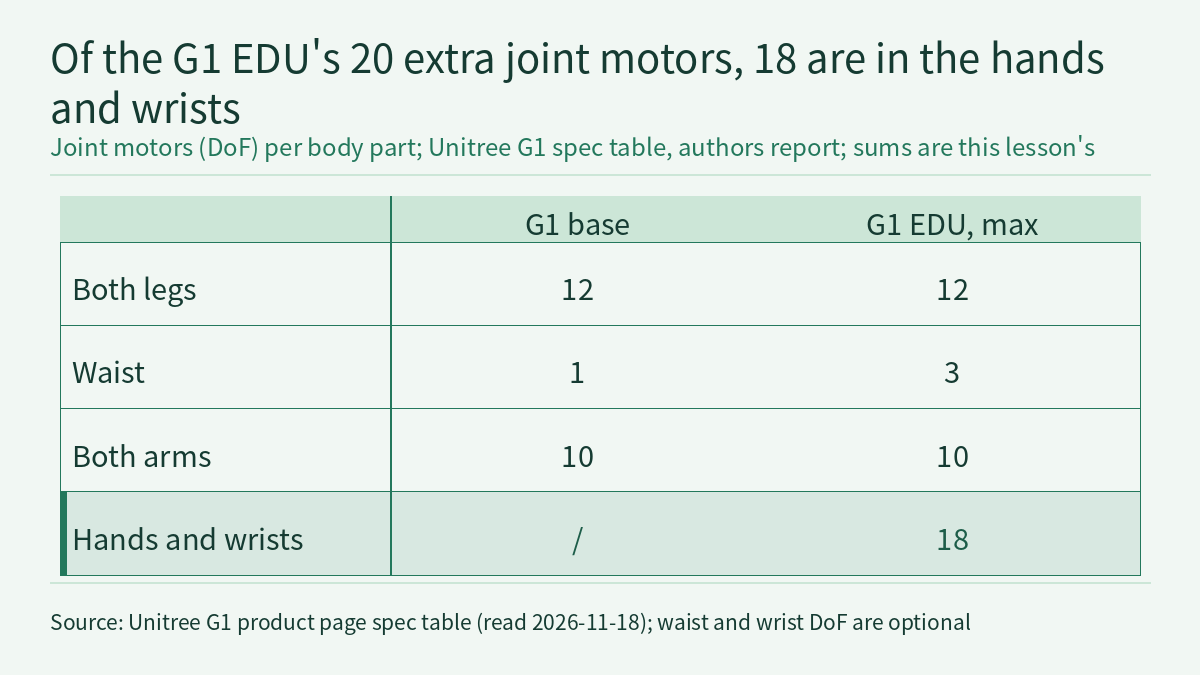
The video for episode 4.1 changes the angle: it looks at the robot’s body instead of the model. A humanoid robot carries dozens of actuators, and each actuator is made of a motor, a gearbox, sensing and control. According to an industry report, actuators are about 40%–60% of the bill of materials (BOM), so for body cost, look at the actuators first. The Unitree G1 cost about $16,000 at launch, far cheaper than a larger humanoid from the same maker, but cheap does not mean it works well. The numbers in the video come from three public sources: Unitree’s G1 product page, The Robot Report’s article on the G1 launch, and the public overview page of humanoid.guide’s The Humanoid Actuation Report. This page is the reading and exercises for the episode. It does not repeat the transcript; it does three things the video concludes without working through. It adds up 23 and 43 item by item from the official G1 spec table and asks whether they share a scope with the report’s 28–44. It looks at where the width of 40%–60% comes from: wherever the actuator’s boundary is drawn, that is where the share lands. And it puts $16,000, $90,000 and the US$13.5K on the official page back on their own terms, separating what can be said from what cannot. One rule runs through the whole page: record a number together with its object, configuration, boundary, source and date; if one of these is missing, the number cannot be compared with another.
The video, transcript and sources for this lesson are at the top of this page; the season plan is in the course outline. The previous lesson, Physical AI Lab 3.6: Reading the Frontier — Reconciling the “About 90%” Figures in a π0 Fine-Tuning Blog Post into One Check Record, Counting the Held-Out Episodes, Then Putting 70% and 50% Back on Their Own Baselines, ended by asking: once we can judge the model, how do we look at the robot’s body and its cost? This lesson picks up from there. The differences between demo, prototype, production and the job were covered in Physical AI Lab 0.5: The Humanoid Robot Boom — Sorting One Passage of Tesla’s Quarterly Update into Demo, Prototype, Production and the Job; that lesson cited an industry analysis (level M) for a G1 starting price of $13,500, and this lesson reads Unitree’s own product page instead. The O/R/M levels and “go back to the one sentence in the source” were practised in Physical AI Lab 0.6: How to Judge Robot News — Tracing Each Question Back to a Sentence in the Source. This lesson does not repeat them. It covers only the three steps an L4 reader takes with material on body cost: count the configuration, find the boundary, line up the prices. The next episode, 4.2, covers safety and compliance: standards and the regulatory timeline.
The public quiz’s 5 questions come with full explanations. Signed-in readers can do three exercises: work out the actuator share of a fictional BOM under two boundaries and see how far a chip swap and cheaper actuators each go; put the G1’s three prices and two sets of specifications back on their sources and review four fictional retellings; and work out the 3-year total cost of ownership of two fictional humanoids, find the downtime cost at which the conclusion flips, and write the questions to ask before ordering. Each comes with a worked solution, common mistakes and a 20-point rubric.
1. The level of each of the three sources, and how far each number reaches
Unitree’s G1 product page is the maker’s description of its own product. In this course’s grading it is level O (official, first-hand); its numbers are reported by the vendor, and this site has not measured a G1. The video’s “twenty-three to forty-three joint motors” comes from this line on the page:
23~43 joint motors
The same page has a spec table with two columns, G1 and G1 EDU, listing the degrees of freedom of each body part, the joint motor type, encoders, cooling, battery life, warranty and price, with 9 footnotes below it. This lesson is based on the page text as read on 2026-11-18.
The Robot Report article covers Unitree’s launch of the G1 at ICRA 2024 and is level M (secondary, media). The price comparison in the video comes from these two passages; the first is about the size of the two machines, the second about price:
significantly smaller in size and stature than the H1 humanoid
The G1 has a list price of $16,000 (base configuration) whereas the H1 has a base price of $90,000.
The article also quotes Unitree’s answer on how it cut cost, used in section 4. Those quotes are what Unitree said in the article; the article did not verify them independently.
humanoid.guide’s The Humanoid Actuation Report is a 249-page paid industry report. This lesson read only its public overview page, not the full report. In the video’s grading it is level M, and its numbers are analyst estimates. The video’s two numbers come from two places in the opening paragraph of the overview:
Between 28 and 44 of them
carry 40 to 60 per cent of the bill of materials
The table below puts the video’s numbers next to their scope. The “Not stated in the source” column was compiled by this lesson; it is the field a retelling most often fills in on its own:
| Number | Source and level | Object and scope | Not stated in the source |
|---|---|---|---|
| 23~43 joint motors | Unitree product page, O | The range across the G1 and G1 EDU columns and their options | The price of each G1 EDU option (the EDU column says only Contact sales) |
| 28–44 actuators | humanoid.guide public page, M | The opening says humanoid robot; the FAQ restricts it to a full-size platform (section 2) | Which robots were counted |
| 40%–60% of the BOM | Same, M | Actuators’ share of the bill of materials; the FAQ says the spread comes from different boundaries (section 3) | Where each estimate draws the boundary |
| $16,000 / $90,000 | The Robot Report, M | G1 base-configuration list price (at the ICRA 2024 launch) / H1 base price (as stated in the article, no date given) | Whether taxes and shipping are included; transaction price |
| US$13.5K | Unitree product page, O | Price in the G1 column, stated to exclude tax and shipping; the EDU column says Contact sales | From when this price applies |
Sign in to keep reading: the rest of this lesson, its self-check questions and the answers.
Limitations
- Unitree’s G1 product page is level O: 23~43, the per-part degrees of freedom, size, weight, torque, load, warranty and US$13.5K are all reported by the vendor, and this site has not measured a G1. This lesson is based on the page text as read on 2026-11-18; the page gives no date for the price, and its footnotes say parameters vary with scenario and configuration.
- The Robot Report is level M; $16,000, $90,000, 127 cm, 180 cm and 47 kg are the article’s figures, and the words of Unitree and Duke Huang are what they said in the article, which did not verify them independently.
- For the humanoid.guide report, only the public overview page was read, not the 249-page paid report; 28–44, 40%–60%, “the largest single block”, the explanation of boundaries and the sentence on torque sensing are all the analysts’ claims (level M), and this site cannot check their estimation methods or sources.
- The following are this lesson’s calculations, summaries or inferences: the per-part sums for 23 and 43, reading the wrist degrees of freedom per side, “one joint motor per degree of freedom”, 17.8% and $74,000, and the summary tables in sections 1 and 4.
- Example machine X, Q-1, P1–P4, R-5 and R-7, robots A and B, and all their numbers are fictional. Paper calculations are not a cost accounting for any product, and none of them is reliability validation or hardware safety validation.
- The video’s “as output climbs, prices may keep falling” is the course’s judgement; none of the three sources gives a price forecast, and this page does not make one.
Links
- Physical AI Lab: a physical AI course where every number can be checked (course outline)
- Physical AI Lab 3.6: Reading the Frontier — Reconciling the “About 90%” Figures in a π0 Fine-Tuning Blog Post into One Check Record, Counting the Held-Out Episodes, Then Putting 70% and 50% Back on Their Own Baselines
- Physical AI Lab 0.5: The Humanoid Robot Boom — Sorting One Passage of Tesla’s Quarterly Update into Demo, Prototype, Production and the Job
- Physical AI Lab 0.6: How to Judge Robot News — Tracing Each Question Back to a Sentence in the Source
- Unitree: G1 product page (spec table and footnotes)
- The Robot Report: Unitree Robotics unveils G1 humanoid for $16k
- humanoid.guide: The Humanoid Actuation Report (public overview page)