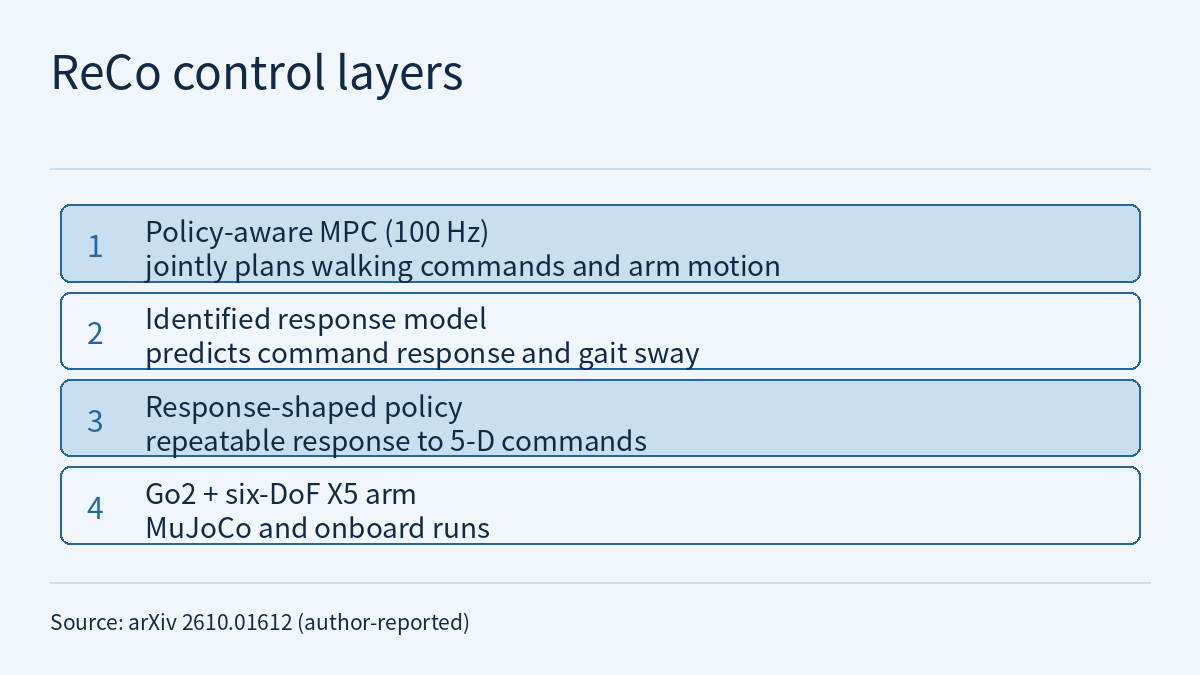
When a quadruped walks with an arm on its back and manipulates at the same time, every step’s translation, pitch change and gait oscillation reaches the end effector. A common division of labor lets an RL policy handle walking and an MPC coordinate base and arm. But MPC can only compensate for base motion it can predict, and a learned policy’s response to the same command varies with gait phase, contact and payload. The preprint ReCo from a National University of Singapore team (arXiv 2610.01612, 2026-10-01) attacks this interface from the other side: first train the policy to respond predictably, then identify its closed-loop response model and hand that model to the MPC. The authors report that on a simulation benchmark of 100 runs, position and orientation RMSE are 28.7% and 27.4% lower than the best baseline for each metric. All numbers below are author-reported [R]; this site has not reproduced them.
The problem is the interface: MPC can only compensate for base motion it can predict
The paper groups related work into three kinds. Purely model-based methods depend on accurate contact and dynamics models, which are hard to maintain on uneven terrain. Learned whole-body control trades off task accuracy and stability within a single reward, which may need retuning across terrains, payloads or disturbances. Modular schemes let RL handle walking and MPC handle base–arm coordination, which moves the difficulty to the interface between them. To the MPC, the base is a closed-loop subsystem whose command response varies with gait phase, contact conditions and payload; assuming a commanded velocity or posture is realized immediately ignores these interactions. The authors also point out that even an accurate mean-velocity model misses the periodic height and attitude motion that propagates to the end effector.
The paper’s central claim is that a walking policy should be not only robust but also predictable by the planner that commands it. The authors’ reasoning is that a consistent delay can be compensated by feedforward, whereas a variable delay cannot; they therefore aim for a response that a low-order model can predict over a useful horizon. This is the authors’ design argument, not an independently verified conclusion.
Method: response shaping, a closed-loop response model and policy-aware MPC
Response shaping
The walking policy is trained with PPO and uses the gait-conditioned command interface of Walk These Ways. The command has five dimensions: planar velocity (x, y), yaw rate, body height and pitch; there is no roll command. “Response shaping” refers to four kinds of training terms added on top of the usual locomotion rewards:
- Reference tracking: each command channel drives a critically damped second-order reference generator (with a configurable bandwidth and rate limit), and the policy is rewarded for matching this target transient. Before comparison, a gait-periodic component, estimated during training with running means over phase and speed bins, is subtracted. The reward is switched off during external disturbances and for an interval afterwards, so recovery takes precedence.
- Phase repeatability: penalizes deviation from the repeatable waveform, not the waveform’s amplitude.
- Steady-state gain: discourages command bias once the response has settled.
- Cross-domain consistency: a group of environments receives identical command sequences and gait phases. Each group has one nominal environment, and the others randomize mass, payload, friction and actuator strength; the randomized instances are pushed toward the nominal environment’s response.
Training is staged: walking first, then reference tracking, consistency penalties, broader randomization and stronger disturbances, in that order.
Closed-loop response model
Each of the three velocity channels is described by a first-order model with a response gain k and a time constant τ. The authors stress that the second-order training reference only specifies a target transient and does not determine the order of the realized closed loop; first order is used to keep horizon optimization compact. Height, pitch and roll get, in addition to the lag, a speed-dependent gait-periodic harmonic term with two harmonics, for the stride and half-stride components. The model does not explicitly model forces and torques caused by the arm. Parameters are identified offline for each frozen policy: step, ramp and chirp commands excite the response across randomized domains, and bounded nonlinear least squares fits multi-step open-loop prediction errors. The identification data are separate from the later prediction and tracking experiments.
Policy-aware MPC
The MPC state has 16 dimensions (9 base states, the gait phase and 6 arm joint positions) and the input has 11 (the 5 locomotion commands plus 6 joint velocities). The cost covers end-effector position, orientation and velocity errors, plus terms for base attitude, command–response discrepancy and arm posture; joint limits, command limits and selected self-collision distances are soft penalties. The solver is OCS2’s multiple-shooting SQP, warm-started from the previous solution at each update. The paper’s configuration: MPC runs at 100 Hz with a 1.0 s horizon, 67 shooting nodes at roughly 15 ms spacing, 3 SQP iterations per update, RK2 integration, on 3 threads. A reference manager samples the plan faster than the MPC update rate and holds the locomotion commands between updates; feedback latency is compensated by propagating the measured state over one sampling interval before optimizing.
The 100 Hz here is the MPC’s update rate, not the frequency of the walking policy or the motors, and the text supplied does not state the policy’s control frequency. The course lesson Physical AI Lab 0.3: See, Think, Act — Putting Each Rate Back in Its Own System teaches exactly this rule: a frequency belongs only to the system that reports it. ReCo is a concrete case: the planning layer does not predict “what the motors did” but “how the closed loop of policy plus robot will respond to a command”.
Simulation benchmark: the tracking results the authors report
The benchmark runs in MuJoCo (2.5 ms integration step) with a Unitree Go2 carrying a six-DoF X5 arm. The terrain is a deterministic 16 × 16 m rolling heightfield with elevations between −0.10 and 0.10 m and an RMS height of 0.0438 m. Fifty world-frame end-effector pose trajectories are generated from randomly sketched paths; some targets lie outside the arm’s workspace at a fixed base pose, so walking is needed to reach them. Each trajectory is run once nominally and once with a push (80 N applied at the base center of mass in the world +X direction for 0.1 s, an 8 N·s impulse), giving 100 runs per controller. All learned controllers are trained in Isaac Gym and evaluated in MuJoCo; ReCo’s walking policy converges in about 10 hours on one RTX 4090 using about 12 GB of GPU memory. The course lesson Physical AI Lab 0.4: Ten Thousand Tries in a Virtual World — Putting the Conditions Back on Three Simulation Numbers introduced Isaac Gym; the training times there differ from this one in task, reward and hardware, and cannot be compared directly.
| Controller | Paradigm | Position RMSE (m) | Orientation RMSE (°) | Mean progress (%) | Success | Falls |
|---|---|---|---|---|---|---|
| Ma et al. | RL+MPC | 0.199 ± 0.114 | 32.7 ± 14.6 | 82.6 | 31/100 | 8/100 |
| Pure MPC | Model-based | 0.189 ± 0.038 | 46.8 ± 14.2 | 80.5 | 19/100 | 12/100 |
| UMI on Legs | Learning | 0.883 ± 0.832 | 81.1 ± 34.3 | 12.9 | 12/100 | 80/100 |
| RoboDuet+PP | Learning | 0.679 ± 0.603 | 79.9 ± 29.0 | 65.7 | 42/100 | 9/100 |
| Visual WBC+PP | Learning | 1.454 ± 1.101 | 68.2 ± 30.1 | 25.0 | 23/100 | 38/100 |
| ReCo | RL+MPC | 0.135 ± 0.091 | 23.8 ± 13.7 | 94.0 | 75/100 | 3/100 |
The 28.7% and 27.4% are computed against Pure MPC, the best baseline on position RMSE, and Ma et al., the best on orientation RMSE, respectively, not against a single baseline. The authors report that paired Wilcoxon signed-rank tests over the 100 runs favor ReCo against every baseline on both metrics (p < 0.001 after Holm correction). ReCo succeeds in 75/100 runs (39/50 nominal, 36/50 push); its mean progress is 11.4 percentage points above the next-best controller, at a mean base speed of 0.205 m/s, comparable to Ma et al.’s 0.217 m/s and above Pure MPC’s 0.158 m/s. Under the push, ReCo’s mean position RMSE rises from 0.1326 m to 0.1371 m (3.4%), versus a 6.4% increase for Ma et al.; the authors note this covers one direction, one duration and one application schedule.
Three things matter when reading this table. First, for runs that fail early, RMSE covers only the recorded portion, so it has to be read together with falls and progress. Second, success is narrowly defined: at least 97% final progress with no fall, numerical fault or early termination; endpoint position and orientation errors within 0.15 m and 40°, held continuously for at least 0.5 s; and at least 40% of samples within both tolerances. Third, every baseline was implemented or retrained by the authors: Ma et al. was reimplemented on the same OCS2 infrastructure, horizon and arm model, and the three learned baselines were retrained for Go2–X5 from their public implementations with a matched training budget. RoboDuet and Visual WBC need externally supplied base velocities, so the authors paired them with a pure-pursuit (PP) tracker. The authors themselves state that the RoboDuet+PP and Visual WBC+PP comparisons do not separate joint planning from differences in the underlying controllers. UMI on Legs reaches position and orientation RMSEs of 0.035 m and 4.7° on in-distribution trajectories, yet falls in 80/100 runs on this benchmark; the authors read this as the difficulty of generalizing from demonstration-derived motions to independently generated trajectories.
Ablations: what shaping and identification each contribute, and at what cost
The authors run a 2 × 2 ablation. Without identification, the MPC assumes commands are executed instantly and exactly.
| Response shaping / model identification | No / No | No / Yes | Yes / No | Yes / Yes (ReCo) |
|---|---|---|---|---|
| Position RMSE (m) | 0.257 | 0.232 | 0.166 | 0.135 |
| Orientation RMSE (°) | 21.7 | 24.3 | 21.5 | 23.8 |
| EE jerk (m/s³) | 252.1 | 250.1 | 261.0 | 249.7 |
| Base jerk (m/s³) | 145.6 | 140.3 | 155.4 | 149.9 |
| Leg torque RMS (N·m) | 6.41 | 6.40 | 6.46 | 6.30 |
Shaping alone reduces position RMSE from 0.257 m to 0.166 m (35.4%). Adding identification to the shaped policy brings it to 0.135 m (18.7%); the same identification on the unshaped policy gives only a 9.7% reduction. This site’s reading is that the more predictable the policy, the more useful the response model. But identification makes orientation RMSE worse: from 21.7° to 24.3° for the unshaped policy and from 21.5° to 23.8° for the shaped one. The authors suggest this may reflect attitude dynamics and translation–rotation coupling that the per-channel response model omits. All four configurations still have lower mean orientation error than the best baseline in Table II. ReCo also does not have the lowest base jerk of the four.
The prediction experiment tests “predictable” more directly. On 36 command trajectories held out from identification, a model of the same structure is fitted separately to the unshaped and the shaped policy, propagated open-loop from measured states under the recorded commands, and evaluated on forward, lateral and yaw-velocity errors at 0.25, 0.50 and 1.00 s. Shaping lowers normalized prediction MSE from 0.105 to 0.042 (59.6%), with improvement at all three horizons. Under 12 matched conditions with the arm executing periodic six-joint motion, forward-velocity residual RMS drops from 0.0345 to 0.0139 m/s; the residual increase caused by arm motion is 0.0040 m/s for the shaped policy and 0.0210 m/s for the unshaped policy. Height residuals do not show the same improvement, even though height is part of the cross-domain consistency term.
The gait-periodic component is evaluated on its own: over 36 trajectories and horizons of 0.10, 0.25 and 0.34 s, height RMSE falls from 6.49 mm to 3.58 mm (44.8%), and a deliberately shifted phase degrades the prediction. Adding this component in closed loop lowers position RMSE by 5.5%, orientation RMSE by 6.9%, and vertical tracking-error RMS in the 1.5–8 Hz trot-excitation band by 6.5%.
Hardware: onboard execution, with two experiments of different evidential strength
The hardware platform combines a Unitree Go2, an ARX X5 six-DoF arm and a Jetson Orin NX onboard computer. The control stack is built on ROS 2 Foxy and runs entirely onboard; the whole software stack, including concurrent programs, uses an average of 75% CPU and 43% RAM.
- Motion-capture experiments: to exclude state-estimation drift, motion capture supplies base-state feedback and end-effector ground truth on 8 trajectories. Mean position and orientation RMSEs are 0.0760 m and 9.93°; the shaped policy lowers them by 29.1% and 7.4% relative to the unshaped policy.
- Task demonstrations: end-effector trajectories for object organization, cabinet-door opening and pick-and-place were prerecorded by VR teleoperation, with 3 runs per task; mean position and orientation RMSEs are 0.153 m and 24.9°. These end-effector poses are reconstructed from onboard odometry and arm forward kinematics, and the authors state explicitly that odometry drift was not measured independently, so these figures describe tracking in the estimated world frame.
Limitations
- This is an arXiv preprint and every number is author-reported [R]. The text this article relies on does not mention a code or data release, and this site has not reproduced any result.
- The main comparison uses one simulation benchmark (one heightfield, 50 trajectories, one push type). All baselines were reimplemented or retrained by the authors, and two of them also depend on a PP tracker the authors added.
- Model identification improves position accuracy but increases orientation error, and shaping does not improve height repeatability. The authors list modeling coupled arm–base dynamics, shaping the height response and extending to perceptive locomotion as future work.
- The response model is identified per frozen policy; after the policy is retrained, the model has to be fitted again.
- The hardware task demonstrations have only 3 runs each, and their end-effector errors are reconstructed from odometry without an independent drift measurement; only the motion-capture experiments provide external ground truth.
Links
- ReCo: Response-Consistent Locomotion with Policy-Aware MPC for Legged Manipulation (arXiv 2610.01612)
- Full paper (HTML)
- Physical AI Lab 0.3: See, Think, Act — Putting Each Rate Back in Its Own System
- Physical AI Lab 0.4: Ten Thousand Tries in a Virtual World — Putting the Conditions Back on Three Simulation Numbers
- Physical AI Lab: a physical AI course where every number can be checked (course outline)