
The preprint Kinematic Hypothesis Context: Embodiment-Conditioned Learned Video Coding for Bandwidth-Limited Robot Policy Uplinks (arXiv 2611.07411, 2026-11-05, by Yuze Lu, Tsinghua University) addresses a setting in which a VLA policy runs on a remote GPU and the robot can send its camera images back only over an uplink of a few kbps. Its starting point is that much of the change in a robot’s camera images is caused by the robot’s own motion, and the receiver already holds the joint angles, the robot model and the camera calibration, so both ends can compute that part themselves instead of spending bits on it. The author reports that in a LIBERO simulation closed loop, the success rate of OpenVLA-OFT under a 6 kbps budget rises from 22.8% to 43.1%. All numbers below are reported by the author [R] and have not been reproduced by this site; every closed-loop success rate comes from simulation.
The problem: the uplink of a remote policy
In the paper’s system model, the policy returns an action chunk every k control steps; for OpenVLA-OFT, k = 8 at a control rate of 20 Hz, so one query every 0.4 s. At each query the robot sends one packet holding its losslessly coded proprioceptive and joint state plus one coded frame per camera. Before decoding that frame, the receiver already holds the previously decoded frames, all joint states, the actions it generated itself, the robot model (kinematic chain and link meshes, shared once per session) and the camera calibration (intrinsics, extrinsics and the hand–eye transform). The author’s examples of low-bandwidth links are field robots on cellular or satellite links, fleets sharing one access point, and underwater platforms, with uplinks said to be a few kbps per robot; this describes the intended applications and is not a measurement.
Physical AI Lab 2.6: To the Edge covered the reasons for putting the model on the robot and avoiding the round trip to the cloud. This paper takes the other option: keep the model on the server and squeeze the uplink as far as possible. Both face the same budget: how long an observation takes from capture to use by the policy.
The mechanism: both ends compute the same reference images from kinematics
Given the joint angles at the previous and the current query, forward kinematics yields the pose of every link, the end effector and the wrist camera. Physical AI Lab 1.1 showed that forward kinematics has exactly one answer, and that matters here: sender and receiver run the same deterministic generator on the same data and obtain the same result, so this “kinematic context” costs no bits. The only extra payload is 7 joint angles beyond the proprioception, and the author states that every such byte is counted in the rate.
From the decoded previous frame, KHC uses kinematics to produce J = D + 5 warped reference images (37 for D = 32), each with a validity mask:
- Identity: content that moves with the camera (the gripper in the wrist view), or the static scene of a static camera.
- Plane sweep (D slots): D fronto-parallel planes at inverse depths spaced uniformly from 1/3 to 12.5 m⁻¹ (3 m to 8 cm), each giving a homography that explains the ego-motion of a moving camera. The paper proves that once camera motion is known, the motion of every static pixel has only one remaining degree of freedom, the inverse depth.
- Robot layer: both ends render only the robot, and each robot pixel moves with its own link; pixels whose rendered depth disagrees by more than 5% + 1 cm are treated as self-occluded and marked invalid.
- End-effector plane: a plane that moves with the end effector and carries grasped objects.
- Background memory: for static cameras, the receiver keeps the background from before the arm covered it, so it need not be resent when the arm moves away.
- Auxiliary slot: used only by the control experiments.
A fusion network turns these references into contexts at three scales, which condition the analysis transform, entropy model and synthesis transform of a DCVC-style conditional codec. The HIST baseline uses the same network and simply fills every slot with the decoded previous frame; both have 7.0M parameters. At very low rates the sender may also transmit only a two-byte slot index (kinematic SKIP), and the receiver displays that reference image. HIST’s SKIP can only repeat the last frame; KHC’s SKIP shows the image at the robot’s current pose.
Why not just feed the pose vector to the codec? The paper’s Proposition 2 shows that a co-located predictor with a limited receptive field, given any global vector, cannot use this information once the displacement exceeds the receptive field. Kinematic knowledge has to become pixel transport. The GVEC control in the experiments (broadcasting the relative camera and end-effector motion as a 24-dimensional vector) tests exactly this.
Coding results: the saved bits come from the robot’s own motion
On 200 test episodes from four held-out LIBERO suites (256 × 256, a third-person and a wrist camera), the author reports:
- At equal PSNR, KHC uses 23.9% fewer bits than the capacity-matched HIST (95% interval −25.0% to −22.8%): 37.9% fewer on the third-person camera and 12.3% fewer on the wrist camera.
- Controls: kinematics from a different episode (SHUF) change the rate by only +1.2% relative to HIST, a second reference frame (HIST2) by +2.9%, and GVEC by −0.6% (interval includes zero). The author concludes that the gain comes from the kinematics, not from capacity or extra temporal context.
- Against x264, x265 and SVT-AV1 in the same low-delay configuration, the savings are 54.9–55.8%, 49.0–49.1% and 39.7%.
- Against the real-time neural codec DCVC-RT: by PSNR, KHC still needs 7.5% more bits (interval −0.5% to 16.4%, not significant); by “action deviation”, it needs 23.2% fewer bits at equal deviation. Action deviation is the L1 distance between the 8 × 7 action chunks OpenVLA-OFT outputs for decoded and for original frames, an open-loop measure.
- The VVC reference encoder VTM-23 still needs fewer bits over the full range (KHC needs 29.0% more in 4:2:0 and 42.1% more in 4:4:4), but it is an offline encoder; citing the DCVC-RT paper, the author puts its low-delay speed at about 0.01 frames per second, while KHC encodes a frame in 26.7 ms. In the low-rate range the closed loop actually uses, the two are roughly on par in LPIPS and action deviation, and VTM-23 keeps its lead in PSNR.
Closed loop: the success cliff and budgets fixed in advance
The closed loop uses the official OpenVLA-OFT checkpoint, unmodified. At each policy query the uplink replaces both camera images with their decoded versions, and the 8-dimensional proprioception passes losslessly. Each configuration runs 4 suites × 10 tasks × 40 initial states = 1,600 episodes with identical seeds, paired by (suite, task, initial state). Without compression, success is 96.9%.
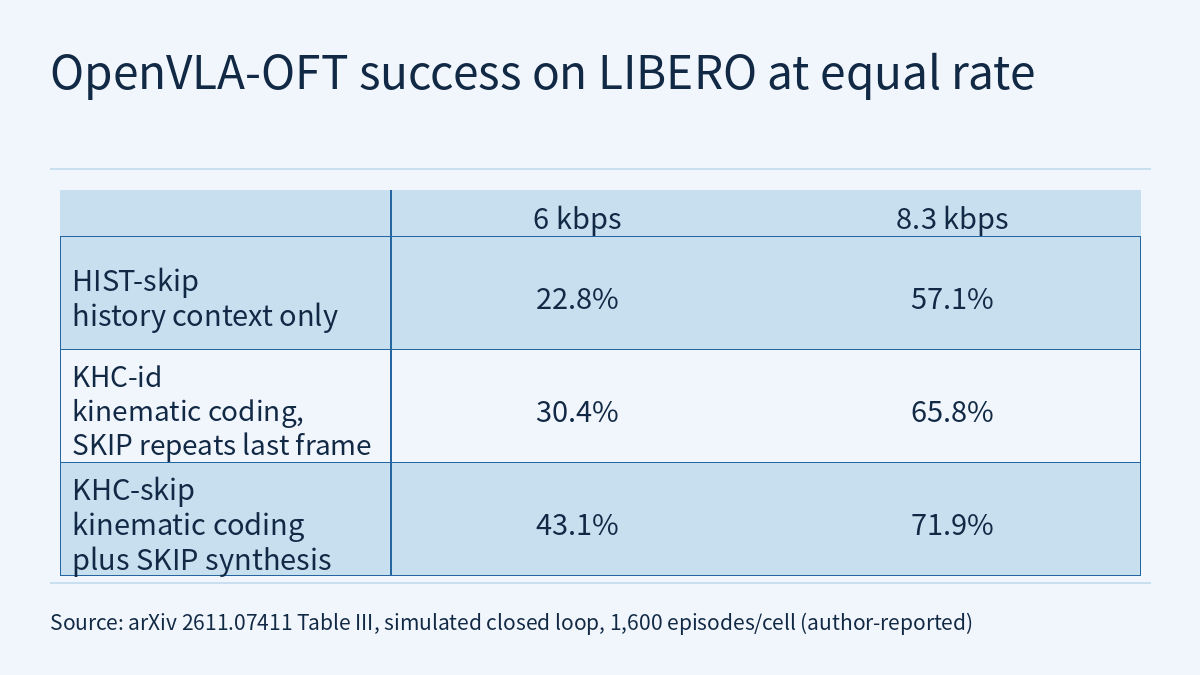
How the budgets were set is worth learning from. A pilot showed that HIST still succeeds in 88.5% of episodes at its lowest native rate point of 9.5 kbps: the policy is saturated over the codec’s whole ordinary range, so no difference can show. The paper’s Proposition 4 says that coding gains turn into task gains in proportion to the slope of the success curve. The author therefore traced the HIST-skip success curve first and, by a rule written in advance, placed the budgets where the curve has risen 30%, 60% and 85% of the way from its floor to the uncompressed level, which gave 6.0, 8.3 and 10.7 kbps, computed on initial states disjoint from the main experiment. The table below is taken from Table III of the paper (the original has two decimals; rounded here to one):
| Uplink | 6 kbps | 8.3 kbps | 10.7 kbps |
|---|---|---|---|
| HIST-skip (history context only) | 22.8% | 57.1% | 85.2% |
| KHC-id (kinematic coding, SKIP can only repeat the last frame) | 30.4% | 65.8% | 88.1% |
| KHC-skip (kinematic coding plus SKIP synthesis) | 43.1% | 71.9% | 88.5% |
| x265 CBR (measured rate exceeds the budget) | 32.4% (9.85 kbps) | 63.8% (12.35 kbps) | 79.5% (15.74 kbps) |
KHC-skip and HIST-skip use the same measured rate (6.07 against 5.98 kbps at the 6 kbps budget, including KHC’s extra joint angles). The differences at the three budgets are 20.4, 14.8 and 3.3 percentage points, all reported as significant after Holm correction (exact McNemar tests; success rates with Wilson 95% intervals). The middle row splits the gain in two: changing only the coding context adds 7.6, 8.7 and 2.9 points; letting SKIP display the kinematic reference adds another 12.8 and 6.1 points at 6 and 8.3 kbps, and nothing at 10.7 kbps, where few frames are skipped. At 6 kbps almost half of all frames are skipped (skip fraction 0.46): a HIST receiver then shows the arm where it was up to several queries earlier, while a KHC receiver shows it where it is now. x265’s rate control cannot reach these budgets, and even using 47–64% more bits it succeeds less often than KHC.
Paired comparison was practised in Physical AI Lab 1.8 and Wilson intervals in Physical AI Lab 2.8; this paper also applies Holm correction for multiple comparisons. It is an example of using these methods in a systems paper: first find the region of the curve that can discriminate, then place budgets there by rule, and pair every configuration on the same initial states.
Stronger comparisons: beyond the headline
The abstract’s “nearly doubles” compares against the capacity-matched HIST. The paper’s extension experiment (initial states 0–19, 800 paired episodes per configuration, 13 tests as one Holm family) gives a fuller picture:
- With DCVC-RT inside the same SKIP and rate controller, KHC-skip reaches 72.4% against 66.6% at 8.3 kbps (a margin the author calls task-dependent) and 88.9% against 69.4% at 10.7 kbps. At 6 kbps DCVC-RT reaches 49.0%, above KHC-skip’s 43.6% (not significant); the author attributes this to DCVC-RT’s lower trained rate range, which lets it skip 6% of frames where KHC skips 45%.
- At 6 kbps, coding 128 × 128 images with HIST and upsampling them bicubically gives 53.1%, also above KHC-skip’s 43.6%; half-cadence transmission gives 47.9% (not significant).
- x265 forced to respect the budget by skipping frames succeeds in only 0.0%, 0.3% and 4.0% of episodes.
- At 8.3 kbps with 10% random packet loss, KHC-skip keeps 46.4% against 22.9% for HIST-skip.
- After both KHC and HIST are fine-tuned to lower rates with the same recipe (KHC-LR, HIST-LR), KHC-LR-skip reaches 72.6% at 6 kbps, 23.6 points above HIST-LR and above DCVC-RT in the same controller (both 49.0%). At 8.3 and 10.7 kbps, however, its lead over HIST-LR is only 5.8 and 3.3 points: lower-rate training itself lifts the history codec considerably.
- A second policy, π0.5 (querying every 5 control steps, 4 Hz), gets its own budgets of 10.0, 13.4 and 16.9 kbps from the same rule. At the middle budget, KHC-skip raises its success from 55.5% to 77.4% (+21.9 points, interval 12.0 to 32.6) at a measured rate of 12.79 against 12.76 kbps.
Read these numbers by their comparison: against the capacity-matched HIST, the gain is present at every budget; against DCVC-RT in the same controller and the 128 × 128 stream, the original KHC does not always lead at the lowest budget, while KHC-LR, retrained for lower rates, leads at all three budgets; the paper does not compare KHC-LR with half-cadence transmission. The author also notes that lower resolution and cadence can be applied on top of KHC.
Deployment conditions: synchronization, calibration and timing
- State and image must be synchronized. A one-frame offset between state and image makes the references misleading, and the rate ends up 43.8% higher than HIST’s; unfiltered pose jitter removes the gain (+3.7%). The author expects hardware-triggered cameras and standard state estimators to provide the synchronization.
- Calibration errors have a second-order effect. With the same erroneous hand–eye calibration at both ends, errors of 1°/5 mm, 2°/10 mm and 5°/20 mm keep 99%, 97% and 91% of the saving.
- Real data was only coded offline. On 30 DROID test episodes from held-out laboratories, the self-calibrated wrist camera saves 11.2% and all three cameras together 4.7%; the two exterior cameras lack usable extrinsics and fall back to HIST by design. The paper runs no closed loop on a real robot.
- Timings were measured on an RTX 4090. A P frame takes 26.7 ms to encode and 17.0 ms to decode (HIST: 23.4 and 13.2 ms), rendering only the robot costs 1.95 ms per camera at each end, and peak memory is 277 MB. The author estimates that on links slower than 55–227 kbps the transmission time saved by fewer bits outweighs the extra computation, and that at 6–11 kbps each observation arrives 90–400 ms sooner at equal PSNR. The main text this site read gives no encoding time on embedded robot-side hardware.
- Fewer planes suffice. In the ablation (all trained 100k steps), D = 4 saves 12.6% over HIST, no worse than D = 32, and the author recommends four planes for deployment. Removing the robot layer raises the rate by 26.4%, the largest single contribution.
- Transport security needs separate handling. The packets the paper describes carry a step counter, the losslessly coded joint state and each camera’s substreams, and session identity is exchanged once at connection time; the main text this site read does not address link encryption or authentication. Joint states and camera images cross this link, so a real deployment should add transport-layer encryption and mutual authentication.
Limitations
- This is a single-author arXiv preprint; all numbers are reported by the author [R] and have not been reproduced by this site. “Pre-registered protocol” is the author’s description; the main text this site read gives no link to a registration record.
- All closed-loop experiments run in LIBERO simulation (re-rendered in MuJoCo through robosuite) with two policies. The only real data is offline compression on DROID, with no closed loop on a real robot; that is what the abstract’s “transfers to real robot data” refers to.
- At 6 kbps the original KHC-skip is below DCVC-RT in the same controller and below the 128 × 128 stream (the former not significant); “nearly doubles” is a comparison with the capacity-matched HIST.
- Limitations the author lists: the method relies on synchronized state and image; exterior cameras without extrinsics currently fall back to HIST; deformable objects, liquids and people in the workspace are not explained by any reference (replacing the plane sweep with rendered scene depth, an upper bound, would save another 18.3%); in PSNR the compact host still trails VTM-23 at medium and high rates.
- “An uplink of a few kbps” is the paper’s application setting, not a measurement of any class of link. The main text this site read ends at the conclusion; the supplementary material was not read.
- All results are coding and simulated task metrics, not hardware safety validation. During skipped frames the policy sees synthesized images, so a real robot still needs an independent safety layer.
Links
- Kinematic Hypothesis Context: Embodiment-Conditioned Learned Video Coding for Bandwidth-Limited Robot Policy Uplinks (arXiv 2611.07411)
- Full text of the paper (HTML)
- Physical AI Lab 2.6: To the Edge — Working Out the Control-Rate Ceiling from a Latency Log, Telling Whether Quantization Saves Size or Time, Then Sizing an Action Chunk
- Physical AI Lab 1.1: Coordinate Frames and Kinematics — Working Out by Hand How a Two-Link Arm Reaches the Cup
- Physical AI Lab 1.8: Evaluation — Splitting a “Net Gain of 2” into a Paired Table, Then Checking the Failure Labels and Random Seeds
- Physical AI Lab 2.8: Reproducible Evaluation — Working Out Wald and Wilson Intervals by Hand, Sizing a Run from 1/√n, Then Bounding the Failure Rate after Zero Failures
- Frontier Radar deep dive | Edge and real-time: where the latency budget of VLAs and world action models goes


