Multi-view VLAs usually receive action supervision only in the robot base frame, so the model has to work out for itself how each camera image relates to displacements in that frame, and this learned correspondence tends to break when a camera moves or the robot starts from a different pose. The preprint OVOA-VLA (arXiv 2611.26161, 2026-11-19, Sun Yat-sen University and X-Era AI Lab) uses known camera extrinsics to convert the states and actions of each demonstration into every camera’s frame, adds one action expert per view to predict them, and after training can drop those experts and run inference with the base expert alone. All numbers below are reported by the authors [R]; this site has not reproduced them.
This site’s Physical AI Lab 1.1 showed that the same cup has different coordinates as seen by the camera and by the base, and that the robot must convert what the camera sees into the base frame before the hand knows where to reach. OVOA-VLA does the conversion in the other direction: it moves the base-frame demonstration actions into each camera frame and uses them as extra training targets. The basic structure of a VLA backbone and its action output is covered in Physical AI Lab 3.1.
How one demonstration becomes several action labels
In the paper, the robot state is the absolute end-effector position, orientation and gripper state in the base frame, and an action is the end-effector translation increment, relative rotation and gripper command. For camera i, the rigid transform from the base to that camera, T_bc (rotation part R_bc), is known:
- State: the end-effector pose is left-multiplied by
T_bc, giving position and orientation in the camera frame; the gripper state is unchanged. - Action:
Δp_c = R_bc · Δp_b,ΔR_c = R_bc · ΔR_b · R_bcᵀ, with the rotation matrix converted back to a rotation vector; the gripper command is unchanged. - Wrist-camera extrinsics change over time. On LIBERO and MimicGen, each step in an action chunk uses the wrist extrinsics at its own timestep; on VLABench and the real Franka, the whole chunk uses the extrinsics at the observation timestep, updated on replanning.
No extra annotation is needed, and the same physical motion gets a label aligned with the image of every view. The cost is that the training data must carry accurate camera extrinsics; for the real-robot experiments the authors calibrated the cameras (details in Appendix D.2).
Two attention graphs and Cross Graph Consistency
The model starts from π0.5 and uses a Mixture of Transformers. A base expert sees the visual tokens of all views and the base-frame state. Each view also gets its own expert, which sees only its own image, takes the state in that camera’s frame and predicts actions in that frame. All action experts share the vision-language backbone and are initialized from the weights of π0.5’s original action expert.
Two directed attention graphs control the information flow between experts. They share parameters and differ only in their attention masks:
- B→R: the view experts’ action tokens may attend to the base expert’s action tokens, and the reverse is blocked. The view experts’ losses flow back into the base expert through these attention connections, while the base prediction does not depend on view-expert features.
- R→B: the direction is reversed, and the base expert can use the view experts’ action features.
In neither graph can different view experts attend to each other directly. During training each sample goes through one forward pass under each graph, with the same inputs, flow timestep and noise. The two resulting base-frame actions share one target, and Cross Graph Consistency (CGC) pulls them together with a mean squared error, applying stop-gradient to a randomly chosen side each time (probability 0.5 each). Loss weights: 1 for the base expert, 0.1 for each view expert, 0.02 for CGC.
Inference has two modes, and both execute base-frame actions. Full mode uses the R→B graph and needs every expert. Base-only mode uses the B→R graph; the base expert does not look at the view experts, so they can be removed, while the images from all views are still provided as input.
LIBERO-Plus: each mode has its strength
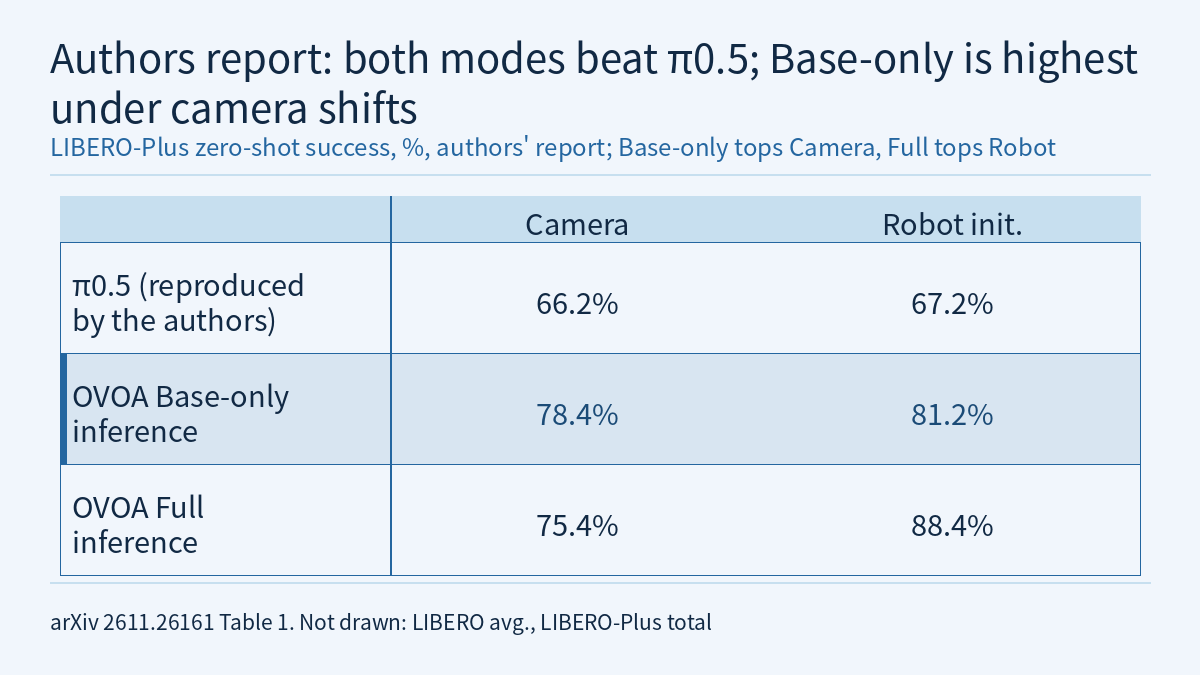
One model is trained per benchmark, for 30,000 steps at batch size 32. LIBERO-Plus is evaluated zero-shot with the LIBERO-trained model, and its total success rate covers 10,030 evaluation instances. The comparison with π0.5 in the paper’s Table 1 (π0.5 reproduced by the authors with the same data and training settings; success rate in %):
| Model | LIBERO avg. | LIBERO-Plus camera perturbation | LIBERO-Plus robot initialization perturbation | LIBERO-Plus total |
|---|---|---|---|---|
| π0.5 (reproduced by the authors) | 92.6 | 66.2 | 67.2 | 77.4 |
| OVOA-VLA Base-only | 96.3 | 78.4 | 81.2 | 85.7 |
| OVOA-VLA Full | 98.7 | 75.4 | 88.4 | 88.1 |
Under camera perturbations, Base-only at 78.4% is higher than Full at 75.4%; under robot initialization perturbations, Full at 88.4% is higher than Base-only at 81.2%. The authors’ explanation is hedged with “potentially”: Base-only does not depend directly on view-dependent action features and may be less sensitive to viewpoint changes, whereas robot initialization perturbations change the motion required, and Full can draw on action features from the other frames. The ablation (Table 4) is consistent with this split: training with the B→R graph only reaches 79.1% under camera perturbations, and the R→B graph only reaches 85.4% under robot perturbations. Putting both directions into a single bidirectional graph gives 77.1% for camera and 71.7% for robot, keeping neither advantage. On top of joint training with both graphs (74.1% and 86.8%), CGC adds 1.3 and 1.6 percentage points.
On other benchmarks, the authors report that VLABench Track 1 average success rises from π0.5’s 42.2% to 56.8% (Base-only) and 60.6% (Full), and ten MimicGen D0 tasks rise from 64.4% to 72.7% and 75.3%.
Base-only inference costs about the same as π0.5
The paper’s Table 5 was measured on the same NVIDIA RTX PRO 6000D at batch size 1 with 10 denoising steps, with latency averaged over 100 runs:
- π0.5: 254.65 GFLOPs, 10.56 GB peak memory, 63.07 ms latency, 92.6% on LIBERO.
- Full (R→B): 263.79 GFLOPs, 19.12 GB, 103.07 ms, 98.7%. Memory and latency rise by about 81% and 63%.
- Base-only: 254.66 GFLOPs, 10.49 GB, 62.77 ms, 96.3%.
FLOPs barely change because most of the compute goes to the shared visual encoder and the PaliGemma prefix encoding, while the action experts process only short token sequences. The table has one more row: inference under the B→R graph with the view experts kept reaches 97.0% on LIBERO, 0.7 percentage points above Base-only’s 96.3%. By the paper’s definition of B→R, the base expert receives the same inputs in both cases, and the text does not explain the gap. The paper reports no seed counts or intervals, so this site cannot tell whether the 0.7 points lie within evaluation randomness.
Real robot: only Base-only was tested on the Franka Research 3
The real-robot experiments use a 7-DoF Franka Research 3 with one fixed third-person camera and one wrist camera. Each of six tasks (three short-horizon, three long-horizon) has 50 demonstrations collected with GELLO teleoperation, pooled to train a single multi-task policy, and every real-robot evaluation uses Base-only mode.
- In distribution: 20 rollouts per task; average success is 77.5% against 72.5% for π0.5, a gap of 5.0 percentage points. The three long-horizon tasks go from 65.0% to 73.3%.
- Spatial distribution shifts: on three tasks, two unseen fixed-camera viewpoints (same wrist camera) and two perturbed initial end-effector poses, with 5 rollouts per task and configuration, zero-shot without retraining. Pooled success rises from π0.5’s 28.3% to 58.3%, and OVOA-VLA is higher on all three tasks.
Working from these settings (our calculation; the paper does not state it), the shift experiment has 60 rollouts per method, so 28.3% and 58.3% are about 17 and 35 successes; the in-distribution experiment has 120 rollouts per method, and 5.0 percentage points is a difference of about 6 successes. The paper gives no intervals. To check how sample size relates to interval width, you can apply the Wilson interval method from Physical AI Lab 2.8.
Limitations
- This is an arXiv preprint; all numbers are reported by the authors [R], and this site has not reproduced them. The main text we read reports no multiple training seeds or confidence intervals and does not say whether code or weights are released.
- π0 and π0.5 are results reproduced by the authors; the other baselines in Table 1 are not marked as reproduced, and their evaluation conditions may not match exactly.
- The method depends on accurate camera extrinsics to build the training labels. By the method’s definition, Full inference needs the state in each camera’s frame and therefore extrinsics at test time; the text does not say which extrinsics Full mode uses under the LIBERO-Plus camera perturbations (our inference; it may be in the appendix).
- The real-robot shift experiment covers only three tasks with 5 rollouts per configuration. The results split by shift type are in Appendix D.3, which we did not read. The third-person camera stayed fixed during demonstration collection.
- LIBERO, LIBERO-Plus, VLABench and MimicGen are all simulations. Neither simulated success rates nor a small number of real-robot rollouts amount to hardware safety validation.
- This article is based on the arXiv HTML text; of the appendix, we read only the part before Table 7.
Links
- One View, One Action: Spatially Generalizable VLAs through Observation-Aligned Experts and Cross Graph Consistency (arXiv 2611.26161)
- Full paper in HTML
- Physical AI Lab 1.1: Coordinate Frames and Kinematics — Working Out by Hand How a Two-Link Arm Reaches the Cup
- Physical AI Lab 3.1: Inside VLAs — Encoding One Cup Motion into 256-Bin Tokens, Then Labelling the Scope of Three Models’ Parameter Counts and Rates
- Physical AI Lab 2.8: Reproducible Evaluation — Working Out Wald and Wilson Intervals by Hand, Sizing a Run from 1/√n, Then Bounding the Failure Rate after Zero Failures
- Physical AI Lab: a physical AI course where every number can be checked (course outline)