
Suvarna Kadam of Witsense AI and Soran Parsa of the University of Huddersfield have posted a VLA survey, arXiv 2611.18372 (2026-11-13), covering 88 works from December 2022 to October 2026. It follows a VLA through its life cycle, from model design to training and deployment, defines seven design axes along the way, places 22 main models on them, and extracts each paper’s training data, parameter count, inference speed and hardware from the full text. When reading a new paper, the axes work as a checklist: which axis the work changes, and whether its reported numbers can be set next to anyone else’s. What follows is the survey authors’ synthesis and extraction [R]; the numbers for individual models are still reported by the original papers’ authors, and this site has not reproduced them.
The 88 works are 5 foundations, 38 manipulation VLAs, 12 navigation VLAs, 5 surveys, and 28 works on humanoid control, world-action models and evaluation. The authors state that this is a structured review, not a systematic one: they started from widely used VLAs, followed their references and citing works, and searched arXiv.
The seven design axes
Four axes describe the model itself, two describe training and one describes deployment:
- Inputs and memory: what the model observes (cameras, language, robot state, extra conditioning) and how much of the past it keeps.
- Architecture: the structure of the whole pipeline, not the backbone network. There are three patterns: a single network; a dual system of a slow VLM and a fast action module trained jointly; and a hierarchy of separately trained models.
- Action output: how vision-language features become motor commands, from discrete tokens to diffusion, flow matching and regression, usually as a chunk of future actions.
- Intermediate predictions: what the model predicts besides actions, either reasoning in text (chain of thought, subtasks) or future observations from a world model.
- Pretraining data: robot demonstrations, data pooled across robot bodies, web data, human video, simulation and generated trajectories, and how they are mixed.
- Post-training: how the model is adapted to a target robot or task, from fine-tuning recipes to reinforcement learning from deployment.
- Real-time execution: how a model running at a few hertz still controls a robot smoothly, through action chunking, asynchronous inference and splits between a remote server and the robot.
One classification detail is worth noting. The authors count π0 as a single network even though its action expert has separate weights, because the expert is part of the same transformer and attends to the VLM’s tokens at every layer; a dual system instead passes a single latent from one network to another. The action heads and parameter breakdowns of OpenVLA, π0 and GR00T N1 are taken apart one by one in Physical AI Lab 3.1 on this site. This article does not repeat that; it looks at how the survey puts many more models into one table.
Table 3: where the 22 models’ choices concentrate
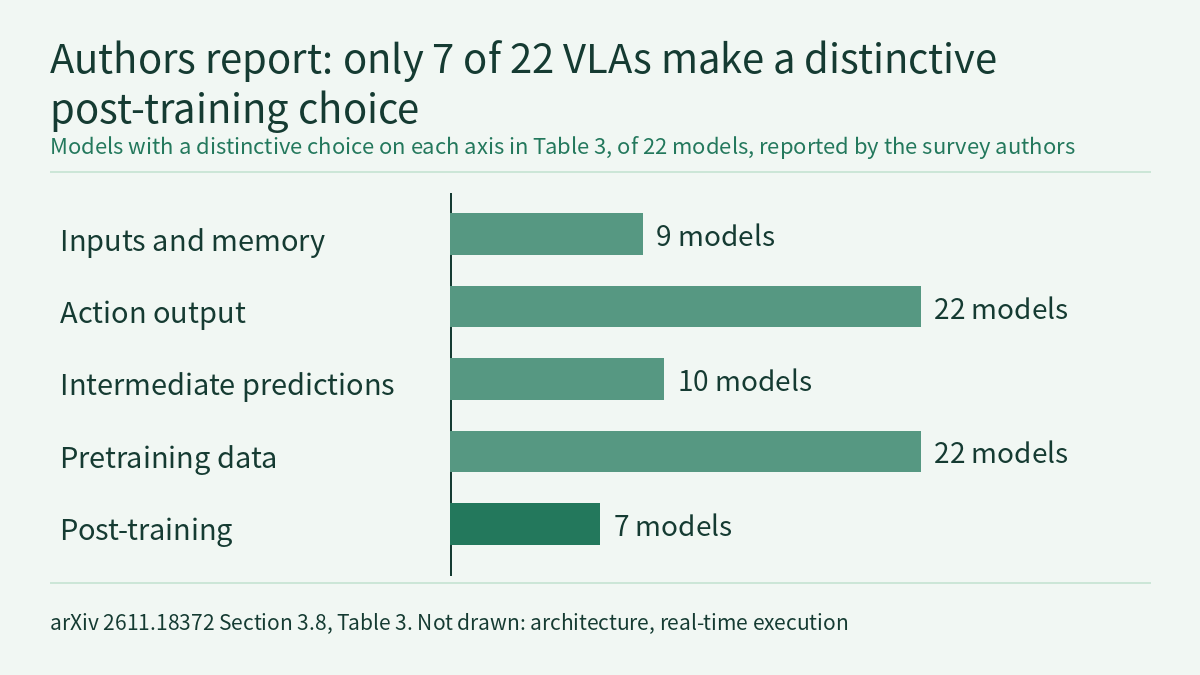
Table 3 in Section 3.8 places 22 models (15 manipulation, 7 navigation) on the seven axes. A dash in the table means the work makes no distinctive choice on that axis, not that the model lacks that part. Reading by column, the authors find that the action output and pretraining data columns have an entry for every model; 9 models extend their inputs; 10 predict something besides actions, and of those only 2, VLA-JEPA and π0.7, predict future observations; only 7 make a distinctive post-training choice. Five of the 7 navigation models add history or extra views to their inputs, which the authors explain by navigation depending on where the robot has been. Reading by row, π0.7 makes a distinctive choice on all seven axes, while RT-2 and OpenVLA do so on four each. This article’s diagram shows the counts for five of the axes; the authors give no count for architecture or real-time execution, so those two are not drawn.
From the entries in Table 3, the 7 models with a post-training entry are OpenVLA (LoRA fine-tuning, quantisation), π0 (task fine-tuning), OpenVLA-OFT (parallel decoding, chunking, L1 loss), π0.6* (RECAP offline RL), π0.7 (metadata conditioning), StreamVLN (DAgger) and VLingNav (online RL). This list is this site’s reading of Table 3. The OpenVLA-OFT recipe raises OpenVLA’s LIBERO average from 76.5% to 97.1% and its throughput by 26×. For how RECAP’s “doubled throughput” reads once it is put back in its experimental conditions, see Physical AI Lab 3.3.
Training data: broader sources, mismatched units
The pretraining scales the survey lists run from about 130k episodes for RT-1 and 970k Open X-Embodiment episodes for OpenVLA to about 10k hours for π0 and about 20k hours for LingBot-VLA; π0.6* states only “tens of thousands of hours”. The sources are broadening too: GR00T N1 used 780k simulated trajectories and about 300k video-generated trajectories, Qwen-VLA used 7.2M simulated trajectories, and GR00T N1.7 added 20k hours of EgoScale egocentric human video to pretraining. GR00T N1.5 to N1.7 are documented only in the release notes of NVIDIA’s code repository, without papers, and the survey states that their data and evaluations cannot be checked to the standard of the other papers.
The problem is the units. Figure 6 can place only the 16 works that report a single episode count; π0 and LingBot-VLA report only hours and cannot go on the same axis. In the introduction the authors list this as an open problem they met directly: a large share of papers describe training data in incompatible units, or do not quantify it at all.
There are results at the low-data end as well. SmolVLA trains on about 23k community episodes (Table 5 records 22.9k episodes from 481 community SO-100 datasets), and TinyVLA, VLA-Adapter and VLA-0 skip robot pretraining entirely. The survey also points out that their strongest results come from simulation benchmarks such as LIBERO, which test much less than real-world use. SimVLA matches far larger models with a minimal 0.5B design and a standardised training recipe, and argues from this that many reported gains are hard to separate from differences in training recipe.
More varied data is not automatically better. The survey cites π0.5’s ablations: data from other robots and environments was important for performance in unseen homes, while web data mainly helped with objects outside the robot data, and its effect on overall task success was not statistically significant.
Model size, deployment speed and the meeting of manipulation and navigation
Parameter counts have split. Most 2025–2026 models have 3–7B parameters, and a group under 1B has appeared: SmolVLA (0.45B), VLA-Adapter and SimVLA (0.5B) and X-VLA (0.9B). RT-2 (55B) is still the largest robot policy in the survey. VLA-Adapter trains in 8 hours on a single consumer-grade GPU.
Speed figures are harder to compare. Table 2 collects the inference speed each paper reports, in each paper’s own units: π0 takes 73 ms per chunk on board on an RTX 4090; OpenVLA-OFT reaches 71.4 Hz throughput and 0.11 s latency on LIBERO on an A100; GR00T N1 takes 63.9 ms per 16-action chunk on an L40; NaVILA runs at about 1 frame per second on an RTX 4090. The authors say plainly that these figures mix throughput, latency per chunk, frames per second and effective control rate, measured on different GPUs, and cannot be ranked directly. Every model that names its hardware runs on a single desktop or data-centre GPU (RTX 4090 or 5090, A6000, A100, L40, H100) or on cloud TPUs; embedded hardware appears only for the edge part of a split system, such as the adapter of AsyncVLA (navigation) on a Jetson Orin. Navigation VLAs built on 7–8B video VLMs are usually served from a remote RTX 4090 or A100 over a network. For timing SmolVLA’s asynchronous inference and choosing an action-chunk length, see Physical AI Lab 2.3 and Physical AI Lab 2.6.
The third trend is generalist VLAs that handle both manipulation and navigation, with UniVLA and Qwen-VLA as examples. Qwen-VLA’s authors report that a single model reaches 97.9% on LIBERO and 59.6% success on RxR. The survey’s reading is that both models unify at the training stage (pooled data, a shared action interface) while their evaluation stays split across separate manipulation and navigation benchmarks; the authors suggest that the main obstacle to a unified model may be shifting from architecture to data and evaluation.
Limitations
- This is an arXiv preprint survey [R]. The authors selected works by three criteria (an original idea, clear progress on a core problem, a tool the community builds on); works that mainly add a small gain or apply an existing method to a new domain are cited but not discussed.
- The Table 3 counts depend on the authors’ judgement of what counts as a “distinctive choice” and on which 22 models were selected; a dash does not mean the model lacks that part. These are classification counts and the survey gives no uncertainty for them; a different set of models could give different counts.
- The numbers the survey extracts are still reported by the original papers’ authors. All four versions in the GR00T N1 line are non-peer-reviewed, and N1.5 to N1.7 have only release notes.
- The full text this site read stops partway through Section 8 (VLAs and world-action models). Section 9 on benchmarks and fair evaluation, Section 10 on open problems and the practitioner’s guide in Appendix A are not in the text read. The abstract says some VLAs with near-perfect benchmark scores fail when objects or the camera move slightly; this article repeats that only from the abstract and has not checked the evidence behind it.
Links
- Vision-Language-Action Models: A Life-Cycle Survey of Design, Training and Deployment (arXiv 2611.18372)
- Full paper in HTML
- Physical AI Lab 3.1: Inside VLAs — Encoding One Cup Motion into 256-Bin Tokens, Then Labelling the Scope of Three Models’ Parameter Counts and Rates
- Physical AI Lab 3.3: RL Post-Training — Putting HIL-SERL’s “2x” and RECAP’s “Doubled Throughput” Back in Their Conditions, Then Recomputing the Paired Interval over Three Seeds
- Physical AI Lab 2.3: Fine-Tuning SmolVLA — Planning Demonstrations for an Instruction, Checking What Each Number Measures, Then Timing the Asynchronous Action Queue
- Physical AI Lab 2.6: To the Edge — Working Out the Control-Rate Ceiling from a Latency Log, Telling Whether Quantization Saves Size or Time, Then Sizing an Action Chunk
- Physical AI Lab: a physical AI course where every number can be checked


