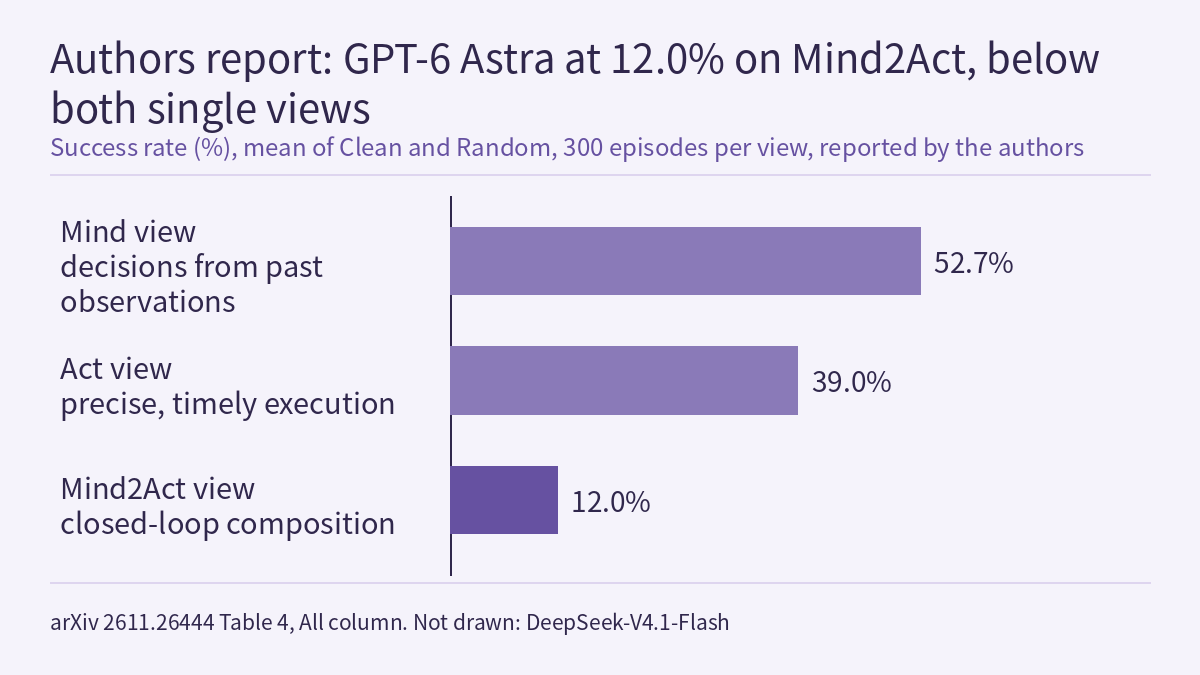
The preprint Mind2Act World (arXiv 2611.26444, dated 2026-11-18 in the paper, with authors from 16 institutions including Tsinghua University) is a simulated manipulation benchmark built around a question that usually gets lumped together: when a robot fails a task, did it forget what to do, fail to carry out the motion, or remember and execute well enough but fail to connect the two? The authors split 30 tasks into three views that are scored separately, and add a failure-attribution tool. They report that the strongest agent, GPT-6 Astra, succeeds in 52.7% of Mind episodes and 39.0% of Act episodes, but in only 12.0% of episodes in the Mind2Act view, which combines both. All figures below are reported by the authors [R] and were not reproduced by this site; this site’s own calculations are marked separately.
What each of the three views tests
The 30 tasks come from five application domains: home and food service, manufacturing and logistics, instruments and tool use, assembly and physical reasoning, and companion and edutainment. They cover 12 capability categories. Each view has 10 tasks, each task has Easy, Medium and Hard levels, and each level is evaluated in a Clean and a Random scene, for 180 configurations. The platform is two ARX X5 arms with parallel grippers in Isaac Sim, with one fixed head camera and two wrist cameras.
- Mind: decisions depend on information that is no longer visible, while execution stays simple. In P2, for example, the robot notes the contents of each steamer basket as it unstacks them, then restacks them in the original order; the Hard level has 4 tiers and 2 decoy baskets that look identical but hold different contents.
- Act: the task states what to do and tests only the precision and timing of execution. In DR4 the robot carries a tray of loose balls past pillars and every ball must stay inside its marked circle; Hard has 4 balls, 2 pillars and a circle of 20 mm radius.
- Mind2Act: remembered information decides the next operation, and the physical outcome of each step changes later decisions. In CP04 the robot adds ingredients in a remembered recipe order, then switches the stove from HEAT to KEEP WARM within 2 s of the pot reaching 80 °C.
Success is decided by physical predicates in the simulator: an object counts as deposited only after it is released and rests supported at the target, and a dial reading must stay stable after release. In DR4 a ball that leaves its circle causes failure even if it rolls back later. The evaluator also records stages and events, which separates “picked the wrong object” from “picked the right one but failed to place it”. Training data for end-to-end policies are 4,500 scripted expert demonstrations totalling 75.8 hours; Mind2Act demonstrations average 99.6 s, Act demonstrations 23.9 s.
Agents and end-to-end policies share the tasks, but not every condition
The authors evaluate nine systems. The agents are three multimodal models, GPT-6 Astra, DeepSeek-V4.1-Flash and Gemini-4-Argon, which are not trained on the benchmark and act through tools: move_eef sets an end-effector pose target, wait_steps advances the simulation, memory_resolve retrieves an earlier observation image from the same episode, and give_up ends the episode. The end-to-end policies are VLAs (KinRT, π0.5, G0.5, X-VLA) and world-action models, or WAMs (InternW0, FastWAM), each fine-tuned from its public checkpoint on the 4,500 demonstrations. Together the nine systems account for 56,700 scored episodes.
Both families see the same tasks, instances and evaluator. Three differences matter when reading the results:
- The simulation clock pauses during inference. Deadlines are counted in simulation time, so a slow model never misses a window, and timed tasks do not measure real-time performance. The paper points out that the strongest agent’s timed successes were obtained under this setting.
- Budgets differ. An end-to-end policy’s episode horizon is 1.2 times the 90th percentile of demonstration durations; agents receive four times this physics budget and at most 150 decisions per episode.
- Sample sizes differ. End-to-end policies run 50 instances per configuration (9,000 episodes per policy); agents run a shared subset of 5 (900 episodes per agent, 300 per view). The two families are ranked on separate leaderboards.
Main result: single-view competence does not carry over to composition
The table below is taken from the agent leaderboard in Table 4 of the paper. Each cell gives task score (0–100) / success rate (%), averaged over Clean and Random. The Overall task score weights the views as 0.25 Mind + 0.25 Act + 0.50 Mind2Act; the Overall success rate is the fraction of all episodes that succeed.
| Agent | Mind | Act | Mind2Act | Overall |
|---|---|---|---|---|
| GPT-6 Astra | 53.9 / 52.7 | 40.4 / 39.0 | 13.3 / 12.0 | 30.2 / 34.6 |
| DeepSeek-V4.1-Flash | 12.4 / 11.0 | 11.3 / 8.7 | 0.3 / 0.0 | 6.1 / 6.6 |
The paper text this site received is cut off at Table 4, so the per-view figures for Gemini-4-Argon and the six end-to-end policies were not read. Elsewhere the text states that no end-to-end policy exceeds 3.6% on Mind2Act. The authors describe GPT-6 Astra as retaining task state but struggling to sustain contact, and the end-to-end policies as responding within a fraction of a second and executing practiced motions while retaining little task state; the memory of the VLAs largely disappears in Random scenes.
GPT-6 Astra’s Mind2Act success rate falls quickly with difficulty: 26.0% at Easy, 7.0% at Medium and 3.0% at Hard. The same model scores 64.0%, 50.0% and 44.0% on Mind and 44.0%, 39.0% and 34.0% on Act at the three levels. GPT-GEAR, covered earlier on this site, also has GPT-6 Astra control an arm directly through tools; that work uses a different tool set and different benchmarks, so the numbers are not directly comparable.
Reading 12.0%: the product reference and the paper’s own caveat
The paper gives a descriptive reference: if a Mind2Act workflow required one independent Mind success and one independent Act success, the expected success rate would be the product of the two. Physical AI Lab 3.4 uses the same multiplication to work out whole-chain success by hand. Using that definition and the numbers in Table 4, this site calculates a reference of 52.7% × 39.0% ≈ 20.6% for GPT-6 Astra, against a measured 12.0%. Split by level, the reference is 28.2% at Easy against a measured 26.0%, which is close; 19.5% at Medium against 7.0%; and about 15.0% at Hard against 3.0%. The harder the level, the further the measured rate falls below the reference. Each level has only 100 episodes per view, so this trend is this site’s reading, not a conclusion of the paper.
Can sampling error explain the gaps between the views? 12.0% corresponds to 36 successes in 300 episodes. This site’s Wilson 95% intervals are about 47.0%–58.2% for Mind, 33.7%–44.6% for Act and 8.8%–16.2% for Mind2Act, and none of them overlap. Appendix D of the paper also gives Wilson intervals; this site did not read that part. The authors note that such intervals reflect only episode sampling over the fixed instance lists, not variation between tasks or between repeated runs. The hand calculation of these intervals is taught in Physical AI Lab 2.8.
Non-overlapping intervals rule out episode sampling as the only explanation; where the gap comes from still has to be judged separately. The paper itself states that the three views contain different tasks and that Mind2Act workflows are longer, so view-level differences do not by themselves identify composition failures; strong single views with a weak combination are only consistent with a composition problem. Matched interventions that hold other factors fixed are left to future work.
The diagnosis tool: assigning each failed episode to Mind, Act or composition
The diagnosis tool passes the evaluator’s stage and event records to rule-based analysis, adds an LLM judge, finds the stage at which each failed episode first breaks down, and attributes the failure to Mind, Act or their composition. The authors attribute failures for three representative systems and summarize each in a “model profile card” of failure patterns and behavioral tendencies. Figure 5 of the paper traces one recorded simulated GPT-6 Astra episode on S1 Medium: task score 0/100, no block in its slot, with the first failure being a wrongly mapped rotated layout, attributed to Mind; the profile card in that figure is illustrative.
Cracking Mobile Manipulation, covered on this site in October, also first finds the earliest unrecovered error in failed episodes and then intervenes; that work targets one fixed VLA system. Mind2Act World puts the same idea into a benchmark: tasks are designed by view, agents, VLAs and WAMs are compared on the same tasks and evaluator, and attributions are summarized per system.
Limitations
- This is an arXiv preprint; all results are reported by the authors [R] and were not reproduced by this site. The paper mentions a project website, code and leaderboards, which this site did not open or check.
- The paper text this site read is cut off at Table 4: the per-view results for Gemini-4-Argon and the end-to-end policies, the analysis by application domain, latency and cost, the real-world discussion and the appendices were not checked.
- Agents are evaluated on only 5 instances per configuration, end-to-end policies on 50; the simulation pauses during inference, so success on timed tasks does not indicate real-time usability.
- Failure attribution uses an LLM judge, and the text read gives no agreement figure between it and human labels.
- All 30 tasks are tabletop abstractions, and the paper says they do not fully reproduce deployed workflows. Simulation success rates are not hardware safety validation.
Links
- Mind2Act World: A Diagnostic Benchmark for Embodied Mind, Physical Action, and Mind-Action Composition in Robotic Manipulation (arXiv 2611.26444)
- Full paper in HTML
- Physical AI Lab 3.4: Long-Horizon Tasks — Working Out Per-Step and Whole-Chain Success by Hand, Seeing Which Quantity Progress Memory Changes, Then Reviewing a Routing Ablation That Swaps Only the Upper Layer
- Physical AI Lab 2.8: Reproducible Evaluation — Working Out Wald and Wilson Intervals by Hand, Sizing a Run from 1/√n, Then Bounding the Failure Rate after Zero Failures
- Frontier Radar | Cracking Mobile Manipulation: 80% on subtasks, 19% once chained into mobile manipulation; attribute each failed episode first, then intervene stage by stage
- Frontier Radar | GPT-GEAR: GPT-6 Astra controls a robot arm directly through five tools, with no trained action policy — how depth, touch and demonstrations are given matters more than whether they are given
- Physical AI Lab: a physical AI course where every number can be checked (course outline)